Every VPN out there claims to be the fastest, most secure option. Say that enough times, and it stops meaning anything. So instead of repeating NordVPN's own pitch, this NordVPN review checks the actual claims, speed, privacy, streaming, and price against independent tests and real customer reviews. Let's see what actually holds up.
Is NordVPN Worth It? The Short Version
For most people who want a VPN for streaming, travel, and everyday privacy, yes, probably. Independent testers keep ranking NordVPN near the top for speed and security. Its no-logs policy has been checked by outside auditors more than once too, which honestly is more than a lot of competitors bother to do.
Weaker fit if you're shopping on price alone. Cheaper VPNs exist that cover basic encryption fine, no frills. And it's really not the pick if you're counting on reliable access from a heavily restricted country. Performance there tends to be spotty. Even reviewers who like NordVPN admit that much.
Is NordVPN Secure? Does It Actually Keep You Private?
Here's roughly what happens: your traffic gets encrypted and routed through one of NordVPN's servers. The company says it doesn't log your browsing activity, connection times, or IP address. That's their claim to make sure, but outside auditors have actually checked this no-logs policy more than once. Plenty of VPNs promise the same thing and never let anyone verify it.
NordVPN is based in Panama. No law there requires companies to store user data, which means no legal requirement forcing them to keep records a government could later ask for. It's one of the more privacy-friendly places a VPN company can sit, and it's a real reason NordVPN keeps coming up favourably in privacy comparisons, not just something marketing repeats.
What's actually protecting you, and why it matters:
-
AES-256 encryption scrambles your data so it's unreadable if intercepted, the same standard banks lean on.
-
NordLynx, their own protocol, handles that encryption without the old speed penalty.
-
Kill switch cuts your internet if the VPN drops, so your real IP doesn't leak out even for a second.
-
Threat Protection blocks malware and known bad sites, keeps working even when you're disconnected.
-
Double VPN routes traffic through two servers when extra protection matters more than speed.
-
Post-quantum encryption built to hold up against decryption methods that don't exist yet.
Is NordVPN safe for banking?
Given the encryption and the kill switch, most reviewers treat it as a reasonable pick for sensitive stuff like that. Still worth pairing with your bank's own security habits though; a VPN isn't a substitute for basic caution.
None of this adds up to zero risk. No VPN can honestly claim that. But between the audits, the jurisdiction, and the no-logs policy, the privacy case here is stronger than average.
Is NordVPN Reliable? Does It Slow You Down?
Every VPN slows you down somewhat. That's just encryption doing its job. Speed depends on your location, your provider, and which server you land on, so exact numbers go stale fast; they're not worth quoting like gospel. Roughly speaking: independent testers in 2026 describe local-server speed loss as small, close to unnoticeable for browsing or video calls. Pick a server clear across the world and that changes: more speed lost, more lag, mostly noticeable in gaming. For streaming and general browsing, testers tend to place NordVPN above the typical VPN.
Streaming: generally unblocks Netflix US, BBC iPlayer, most major platforms, according to testers. Worth knowing streaming services actively try to detect and block VPN traffic, so nothing here is permanent. Work today doesn't guarantee work in six months. NordVPN's track record has held up better than most, but "reliably unblocks" really means "usually works."
Torrenting: P2P-optimized servers handle it well in independent tests.
Public Wi-Fi: probably where a VPN earns its keep the most, honestly. Coffee shops and airports are common interception targets. An encrypted, kill-switch-protected connection just closes that gap, no thinking required.
NordVPN Review for iPhone and Android
The iOS app covers the basics well: encryption, kill switch, server switching, but no split tunnelling. That's an Apple limitation on VPN permissions, not something NordVPN chose to skip. Android gets split tunnelling, so you can route only certain apps through the VPN while everything else runs normally. Both apps get decent marks for being simple to set up, nothing overly technical unless you go digging.
NordVPN Reviews & Ratings: What People Actually Say
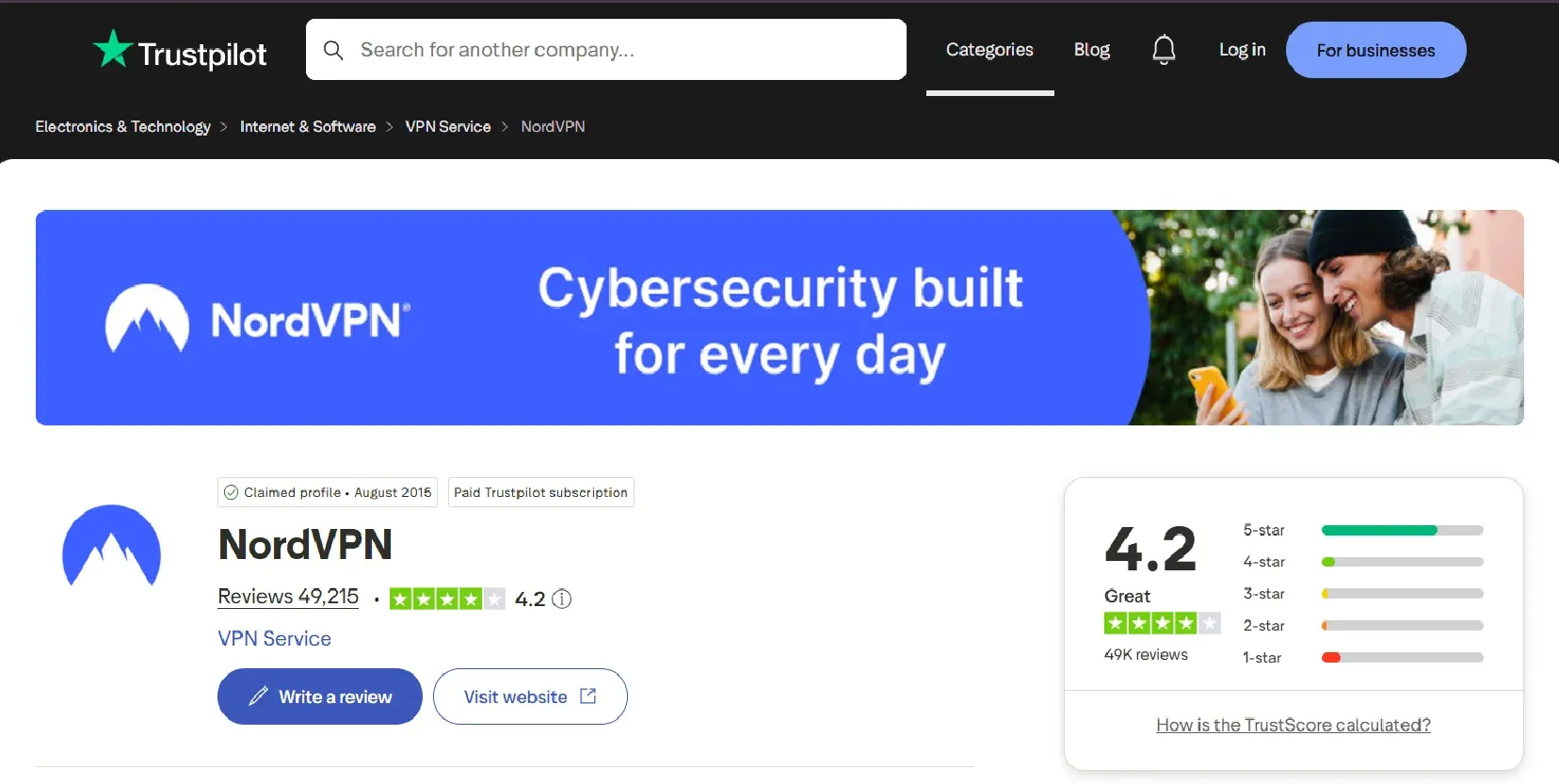
NordVPN generally sits with strong ratings across Trustpilot, the App Store, Google Play, comfortably above average for the category, with a decent volume of reviews backing that up, not just a handful. Numbers shift constantly though, so worth checking current NordVPN ratings directly rather than trusting a figure printed here.
What's inside those numbers matters more than the average score anyway. Positive NordVPN customer reviews keep mentioning speed, ease of use, and, a little unusually for a tech company, customer support. Reviewers name specific agents as helpful and fast, which isn't something you see often. Scroll through NordVPN experiences on forums and review sites and the overall lean is positive.
Checking NordVPN customer reviews on Trustpilot is one of the fastest ways to see how it has actually gone, straight from people who've used the site rather than the marketing copy.
On Trustpilot, NordVPN holds a "Great" rating of 4.2 out of 5, based on roughly 49,000 reviews. The breakdown skews heavily toward 5-star and 4-star ratings, though a smaller share of 3-star, 2-star, and 1-star reviews point.
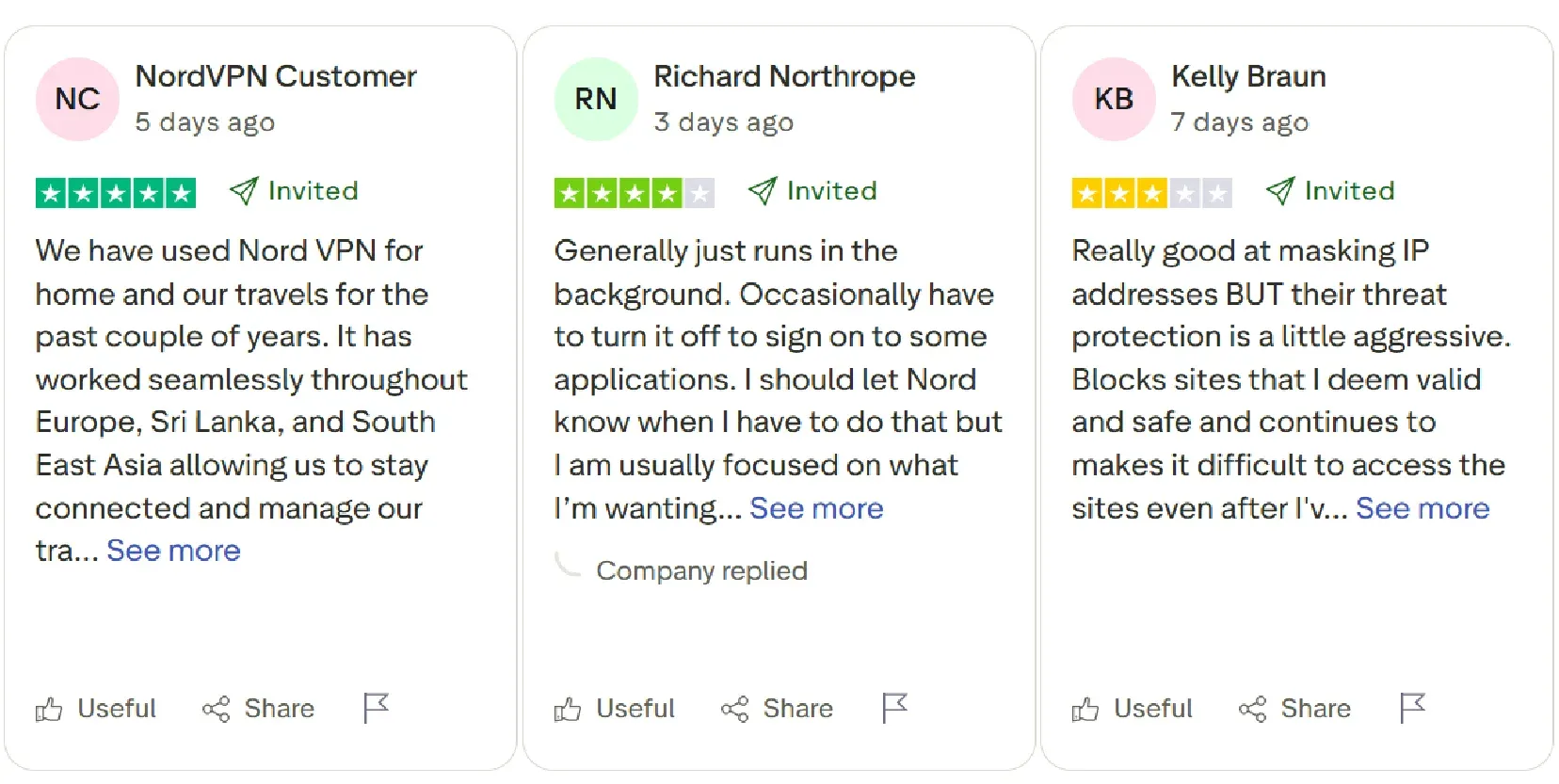
Negative reviews cluster somewhere else entirely: billing. The recurring complaint is the price jump after the first term ends, catching people off guard if they weren't watching their renewal date. Fair complaint, honestly, not a security issue, more a pricing transparency one.
Is NordVPN the Best VPN?
Independent comparison sites tend to put NordVPN at or near the top for feature depth, server size, streaming reliability. Where it doesn't automatically win is price, budget alternatives cover basic encryption and a kill switch for less, especially if Double VPN and the extras aren't things you'll ever touch. Simple needs, price-driven decision? Worth comparing first. Want the fuller feature set and don't mind paying a bit more? NordVPN holds up as one of the stronger picks out there.
Getting the Best Price on NordVPN
Multi-year plans generally beat shorter terms on per-month value, pretty standard across VPN pricing. The catch, and it's the one people complain about most, renewal pricing after your first term climbs, sometimes by a lot. A calendar reminder near your renewal date saves you from an unpleasant surprise.
Free trial availability varies by platform and region, worth checking what's current on NordVPN's own site. Paid plans carry a money-back guarantee window, usually around 30 days, a real chance to test things before fully committing.
Before subscribing, check Coupondopa US for an active NordVPN discount code. Multi-year plans already carry the deepest built-in discount, so a working code stacked on top knocks the upfront cost down further. Codes are typically single-use, so apply it to your whole order rather than splitting things up.
What Is NordVPN, Exactly?
A VPN encrypts your internet connection and routes it through a remote server, hiding your real IP and protecting your data from anyone trying to intercept it on shared networks. NordVPN's one of the largest, longest-running VPN providers around, running a large server network across 100-plus countries, and it's built a reputation as one of the more security-focused, feature-heavy options in a crowded market.
Is using NordVPN illegal?
No, not in most countries, including the US, UK, and most of Europe. A handful of countries do restrict or ban VPN use, so it's worth checking local rules if you're travelling somewhere with strict internet laws.
Who Should Buy NordVPN?
Best for: streamers wanting solid Netflix and BBC iPlayer access, travellers and public wifi users wanting strong security without fiddling with settings, privacy-conscious users wanting an audited no-logs policy, anyone who wants extra security layers sitting there even if unused daily.
May be disappointed: budget shoppers needing only basic encryption, anyone relying on a VPN for steady access from a heavily censored country, iOS or macOS users needing full split tunnelling.
Pros:
-
Independently audited no-logs policy, based in privacy-friendly Panama.
-
Strong, consistent performance in independent testing.
-
Solid track record unblocking major streaming platforms.
-
Deep security feature set: Double VPN, Threat Protection, post-quantum encryption.
-
Strong ratings across review platforms, support frequently praised.
Cons:
-
Renewal pricing climbs after the first term.
-
No port forwarding.
-
Split tunnelling limited to Windows and Android.
-
Inconsistent access in heavily restricted countries.
-
No free plan; trial availability varies by platform.
FAQs
Is NordVPN worth it?
For most people prioritizing streaming, privacy, and public wifi safety, generally yes. Weaker fit for strictly budget-driven shoppers or anyone needing guaranteed access in heavily censored countries.
Is NordVPN safe?
Yes. Independently audited no-logs policy, based in privacy-friendly Panama, AES-256 encryption plus a kill switch that keeps you covered if the connection drops.
Is NordVPN the best VPN?
Ranks at or near the top in most independent comparisons for speed, security, and streaming. Budget alternatives might suit simpler needs better.
Does NordVPN work with Netflix?
Generally, yes, though streaming access can shift as platforms update how they detect VPN traffic.
Is using NordVPN illegal?
No, VPN use is legal in most countries. Worth checking local laws first if you're heading somewhere with strict internet regulations.

Total Views
306
Published On
Jul 21, 2026
Rate This Review
Was this review helpful? Rate it to help others.
"Where quality meets elegance, and every product tells a story of excellence."