.webp)
If you are thinking about joining Amazon Associates, money is probably the first question on your mind. How much can you actually make? Is Amazon Affiliate Marketing still worth it in 2026? This guide walks through the real numbers, the market data, and where the program is headed, so you can plan with facts instead of guesswork.
Amazon Affiliate Revenue Insights
Most people who sign up for Amazon affiliate marketing never see big checks. A small group earns a full income from it. An even smaller group builds a business worth six figures. That does not mean the program is broken. Results depend heavily on your niche, traffic, and how consistently you stay with your content.
Here is what the numbers actually look like broken down by experience level.
|
Experience Level |
Typical Monthly Earnings |
|
Beginner (0 to 6 months) |
$50 to $300 |
|
Intermediate (established traffic, 1 to 3 years) |
$1,000 to $5,000 |
|
Advanced (authority sites, strong SEO, large channels) |
$10,000 to $50,000+ |
Beginners spend their first few months earning very little while they build content and wait for search rankings to catch up. That stage is normal. It is not a sign you are doing something wrong. Intermediate affiliates who have found their niche and built consistent traffic tend to land in a much more comfortable range, often between $1,000 and $5,000 a month. At the top end, advanced affiliates running authority websites or large YouTube channels can clear $10,000 a month, and a small few push into six figures.
Industry research backs up how rare that top tier really is. Only 10 to 20 percent of affiliates earn enough to call it a primary income. Just 1 to 5 percent of that group reach six figures. The rest sit somewhere between a small side income and nothing at all.
That is the honest starting point. The rest of this guide breaks down why those numbers look the way they do, and what you can do to land on the better side of them.
How Much Can You Make with the Amazon Affiliate Program
.webp)
Your earnings come down to one formula: traffic, conversion rate, and commission percentage. Change any one of those and your income changes with it.
Commission rates on Amazon range from 1 percent to 20 percent depending on the product category. Here is the current amazon affiliate commission list broken down by category.
|
Category |
Commission Rate |
Example Earning on $100 Sale |
|
Amazon Games |
20% |
$20.00 |
|
Luxury Beauty, Amazon Explore, Handmade |
10% |
$10.00 |
|
Furniture, Home, Kitchen |
3% to 4.5% |
$3.00 to $4.50 |
|
Electronics |
Around 3% |
$3.00 |
|
Grocery, Health |
1% |
$1.00 |
A $50 sale in a low commission category like electronics might earn you around $2. That same $50 spent in Luxury Beauty earns you $5. A $100 skincare purchase in that category pays $10. Small percentage differences add up fast once you are sending hundreds of clicks a month, which is exactly why checking the Amazon affiliate Program commission table before picking a niche saves you a lot of wasted effort later.
Beyond product sales, Amazon also runs a bounty program. This pays a flat fee, not a percentage, when someone signs up for something like a free trial or a subscription through your link. It is an easy way to add extra income without relying only on purchases.
Affiliates working steadily report monthly income anywhere from $3,000 to $15,000, though that range leans toward experienced publishers with established traffic. New affiliates should expect a slower climb. Most people spend their first several months earning very little while they build content and search rankings. That is normal. It is not a sign of failure.
Amazon Affiliate market size (From 2020 - 2026)
.webp)
Covid changed how people shop, and that shift never fully reversed. When stores closed in 2020, millions of shoppers who had rarely bought much online suddenly had no other option. Many stuck with online shopping even after stores reopened, since it turned out to be more convenient. Brands noticed too. Between 2020 and 2022 alone, business interest in affiliate marketing grew by more than 264 percent, as companies looked for a lower-cost way to reach shoppers who were already spending more time online.
|
Period |
Market Signal |
|
2020 to 2022 |
Business interest in affiliate marketing up over 264% |
|
2024 |
Global affiliate marketing industry valued at over $17 billion |
|
2024 onward |
Steady growth pace of close to 9% to 10% a year |
That growth did not stop once the pandemic eased. Amazon has stayed at the center of it the whole time, since it remains the easiest entry point for anyone starting Amazon Affiliate Marketing. You can read more detailed affiliate marketing statistics if you want the full year by year breakdown.
What makes this growth different from past spikes is that it has been steady rather than sudden. A short burst of interest usually fades fast. Years of consistent single digit growth after a pandemic spike suggests shoppers simply changed their habits for good.
Amazon affiliate market projection (2026 - 2030)
.webp)
The forecasts for the next few years point one direction: up.
|
Year |
Projected Global Affiliate Market Size |
|
2026 |
Around $19 billion to $20 billion |
|
2027 |
Around $27.78 billion |
|
2030 |
Between $36 billion and $38 billion, depending on the source |
A few forces are driving that. More brands are moving ad budgets away from expensive paid campaigns and into affiliate programs, since affiliates only get paid when a sale actually happens. AI tools are also making it easier for smaller publishers to create content faster. That means more people entering the space and more total traffic flowing through affiliate links. Mobile shopping keeps growing too, and mobile traffic already makes up well over half of all affiliate clicks.
None of this guarantees rising commissions for individual affiliates. Amazon has cut category rates before and could do it again. The overall pool of affiliate spending is still expected to keep growing through the end of the decade though, which is good news if you are building a long term presence in the space.
Top amazon affiliate sectors (Fashion, home and garden, daily use items)
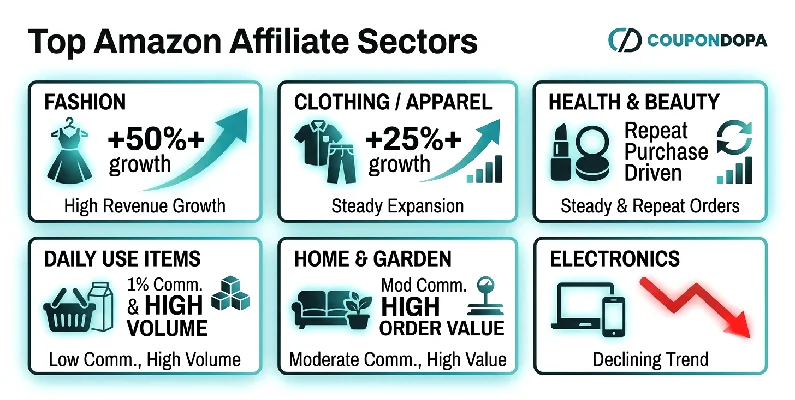
Not every category grows at the same speed. Picking the right one matters almost as much as picking the right products.
|
Sector |
Recent Trend |
|
Fashion (accessories, jewelry) |
Revenue growth above 50% year over year |
|
Clothing and apparel |
Growth of more than a quarter in the same period |
|
Health and beauty |
Healthy growth, helped by repeat purchases |
|
Daily use items |
Lower commission rates, often close to 1%, but high purchase volume |
|
Home and garden |
Moderate commission rates, higher average order values |
|
Computers and electronics |
Recent drop in affiliate revenue |
Fashion has been one of the strongest performers recently. Shoppers keep buying seasonal wardrobe items and gifts through affiliate links, which keeps this category active all year.
Health and beauty grew at a healthy pace too. People rarely buy skincare or supplements just once. They buy the same products again and again, which gives affiliates in this space a shot at building a loyal, returning audience.
Daily use items carry lower commission rates but make up for it in volume. People buy household basics constantly. Once a piece of content ranks well for something people search every month, it can keep earning small commissions on autopilot for years.
Home and garden sits in the middle. Commission rates are moderate, but average order values run higher, since furniture and outdoor equipment cost more than a bottle of shampoo. A single sale here can be worth several times a sale in daily essentials, even at a similar commission percentage.
Some categories moved the other way. Computers and electronics saw a noticeable drop recently, along with food, drink, and gift categories. Worth remembering: trends shift, so keep an eye on which sectors are gaining ground instead of sticking with one niche forever. Speaking of affiliate sales, you can also use Coupondopa to even boost your affiliate program incomes by saving some amount on your other products.
How Does the Amazon Affiliate Program Work?
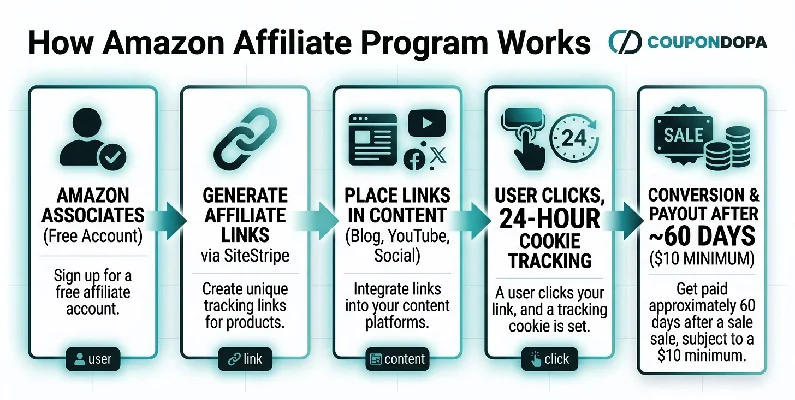
The mechanics are simple once you break them into pieces.
Start by signing up for a free Amazon Associates account. This is where amazon affiliate marketing sign up free comes in, since there is no cost at any step. Once approved, you generate an amazon affiliate link using a tool called SiteStripe, which sits right on Amazon product pages once you are logged in. You place these links in your content, whether that is a blog post, a video description, or a social media bio.
If your audience lives mainly on Instagram or YouTube instead of a blog, the Amazon Influencer Program is worth a look too. It works on the same commission structure as Associates but gives you a shoppable storefront built for social traffic instead of website links.
When someone clicks your link, a tracking cookie attaches to their browser. This trips up a lot of new affiliates. Amazon's cookie only lasts 24 hours. If someone clicks your link and buys something two days later, you likely will not get credit, unless they added the item to their cart within that window, in which case you still get paid even if they check out later.
Once you are approved, your amazon affiliate login gives you access to a dashboard showing clicks, conversions, and earnings. Checking your amazon affiliate marketing insights login page regularly helps you catch which links are actually converting, so you are not guessing which content is doing the work.
Commissions get confirmed after returns and cancellations are accounted for, then paid out roughly 60 days after the month closes. A sale in January typically gets paid out around late March. You also need to hit a minimum earnings threshold before Amazon releases payment. For direct deposit, that threshold is just $10, which makes it one of the easier programs to actually get paid from.
Amazon Associates Program – Eligibility & Approval Requirements
Getting approved takes more than just signing up. Amazon wants to see a real, functioning website or channel with actual content on it, not a blank page waiting for links.
As of April 2026, Amazon added a stricter rule around qualifying sales. Products now need to be shipped, streamed, or downloaded, and fully paid for, within 180 days of the click for the sale to count. Amazon also tightened its definition of original content, requiring posts to include real commentary or analysis rather than just a list of products with nothing added.
Common reasons applications get rejected: no content published yet, too little traffic to review, or a site that looks like it exists only to push links with nothing useful for the reader. The fix is straightforward. Publish a handful of genuinely helpful posts before you apply, and make sure your site has clear navigation and real information beyond product links.
Amazon Revenue Model and Where Affiliates Fit In
Amazon's affiliate program is a small but important piece of a much larger business. The company earns most of its revenue from direct retail sales, third party seller fees, and its cloud computing arm. Affiliates fit into this picture as a low cost customer acquisition channel. Instead of spending on ads upfront, Amazon only pays a commission after a sale has already happened, which makes the program essentially self funding.
Sellers benefit from this system too, not just publishers. The Amazon Seller Affiliate Program, through tools like the Brand Referral Bonus, rewards sellers who bring their own outside traffic, from their own site or social channels, to a sale on Amazon. It gives sellers a reason to work with affiliates and influencers directly to promote their own listings, on top of whatever traffic Amazon's search already sends them.
That structure explains why Amazon Associates remains one of the largest single affiliate networks in the world. Estimates of its exact market share vary depending on the study, ranging from around one fifth of the entire affiliate industry up to nearly half. Every estimate agrees it is one of the biggest players by a wide margin. For Amazon, affiliates act like an army of independent marketers who bring in shoppers Amazon would otherwise have to pay to reach directly through ads.
Best Alternatives to the Amazon Affiliate Program
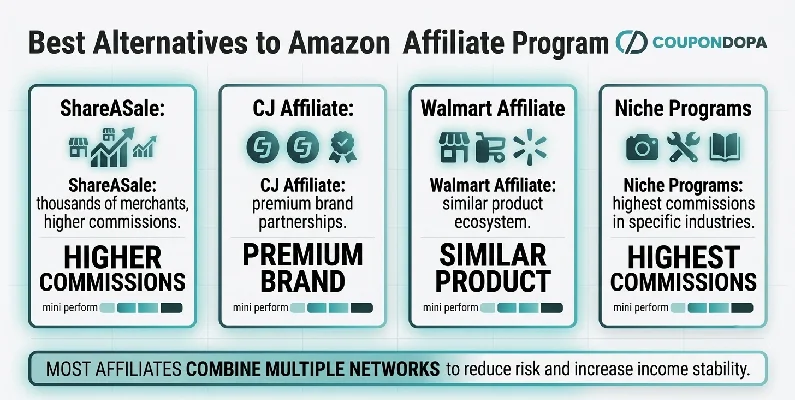
Amazon is a great starting point, but it is not the only option. Relying on a single program carries risk if rates change again.
|
Alternative |
Known For |
|
ShareASale |
Thousands of individual merchant programs, often higher rates |
|
CJ Affiliate |
Large, well known brand partnerships |
|
Walmart Affiliate |
Similar product range to Amazon, longer cookie window in some cases |
|
Niche specific programs |
Higher commissions in categories like outdoor gear or software |
Most successful affiliates do not rely on just one program. Running Amazon affiliate marketing campaigns alongside a couple of other networks means a rate cut or policy change in one place does not wipe out your entire income at once.
FAQs
Is Amazon affiliate marketing sign up free?
Yes. There is no cost to join Amazon Associates at any point, though you do need an existing website or channel with real content before you apply.
How do I check my amazon affiliate marketing insights login page?
Log into Amazon Associates with your account email and password. Once inside, your dashboard shows clicks, conversions, and total earnings for all your active links.
What is the difference between Amazon Associates and the Amazon Influencer Program?
Associates is built for website and blog owners using SiteStripe links. The Influencer Program is built for social media creators and gives them a shoppable storefront instead.
Where can I find the full amazon affiliate commission list?
Amazon publishes its category rates inside the Associates dashboard, and they range from 1 percent on categories like grocery up to 20 percent on Amazon Games.
Can sellers use the Amazon Seller Affiliate Program too?
Yes. Sellers can use tools like the Brand Referral Bonus to reward outside traffic they bring in themselves, working alongside affiliates and influencers to promote their own listings.