
Disclaimer: This is an independent study of selected retailers and online discount offers, not an analysis of CouponDopa's own coupon inventory. Findings are based on the offers and checkout conditions tested during the research period.
We checked 17 retailers across 10 markets to see whether the discounts shoppers see advertised are the savings they actually receive at checkout.
Introduction
A discount banner is usually the first thing shoppers notice when they visit an online store. A large percentage sits above the product image, appears in search results, or follows customers through email campaigns and social media ads. Fifty percent off. Sixty five percent off. Save up to ninety five percent.
These numbers are designed to answer one question quickly. How much can I save if I buy this today?
The answer is not always as straightforward as the percentage on the screen suggests. A product advertised with a 50% discount does not always mean every shopper pays half the original price. Sometimes the offer applies only to selected products. Sometimes the biggest discount applies to only a few items. Sometimes conditions such as minimum spending requirements or discount caps change the final amount.
The advertised discount tells shoppers what a retailer wants them to notice. The real checkout code tells them what they actually get.
In this study, 17 retailers across 10 markets are compared. These two numbers are the headline discount each retailer advertises publicly and the verified sitewide code confirmed as usable at checkout.
The goal was not to find the biggest discounts. The goal was to find out how closely advertised savings match the code a shopper can genuinely use.
The Question Behind This Research
Online discounts have become a normal part of ecommerce. Retailers use promotions throughout the year to attract new customers, clear inventory, increase sales during seasonal events, and encourage shoppers to complete purchases.
A discount percentage is one of the simplest ways to communicate value. A shopper may not know whether a product is fairly priced, but a discount number immediately creates a comparison.
Discount percentages can also hide important details. A retailer advertising "up to 65% off" is communicating the highest possible discount available. It does not necessarily mean most products receive that reduction. Similarly, "30% off selected items" may represent a genuine promotion, but the customer's chosen product may not qualify.
This raised a simple question worth testing directly: how different are advertised discounts from the code shoppers can actually use? That question became the foundation of this research. (Source: Bargain Hunters Beware: A Store's 'Original Price' Might Not Be After All | Working Knowledge).
Why CouponDopa Looked Into This
Coupon platforms exist around one simple idea: helping shoppers save money. CouponDopa helps shoppers discover coupon codes and online deals while making it easier to understand whether those promotions deliver real value. Saving money online is not only about finding promotions. It is also about understanding whether those promotions deliver real value.
A discount percentage can look impressive while still leaving shoppers unsure about the code they will actually use. We wanted to measure the difference between the number shown in a promotion and the code that is genuinely live and usable sitewide. (Source: FTC reportedly looking into Amazon's price listing practices | Retail Dive).
The Biggest Finding
The biggest finding from this research was the gap between the advertised headline and the real sitewide code. Across 17 retailers, 16 of which use percentage based promotions that can be compared this way, the average advertised discount was 44.7%. The average real sitewide code shoppers could actually use was 17.8%. The difference between those two numbers averaged 26.9 percentage points, a figure we call the discount gap.
|
Measurement |
Result |
|
Average advertised discount |
44.7% |
|
Average real sitewide code |
17.8% |
|
Average discount gap |
26.9 pp |
|
Median advertised discount |
50% |
|
Median real sitewide code |
15% |
|
Median discount gap |
30 pp |
These findings show why shoppers should look beyond the largest percentage displayed in a promotion. A bigger discount number does not automatically mean a bigger saving.
Research Snapshot
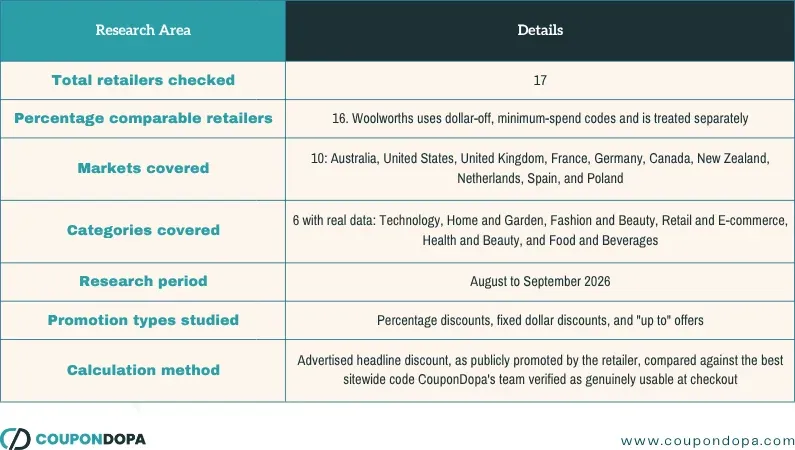
This is a focused check across 17 real, named retailers rather than an exhaustive market survey. Every figure below traces back to a specific, named store. Where a category or market only has one or two retailers behind it, that limitation is noted directly rather than presented as a broad trend.
Every Retailer Checked
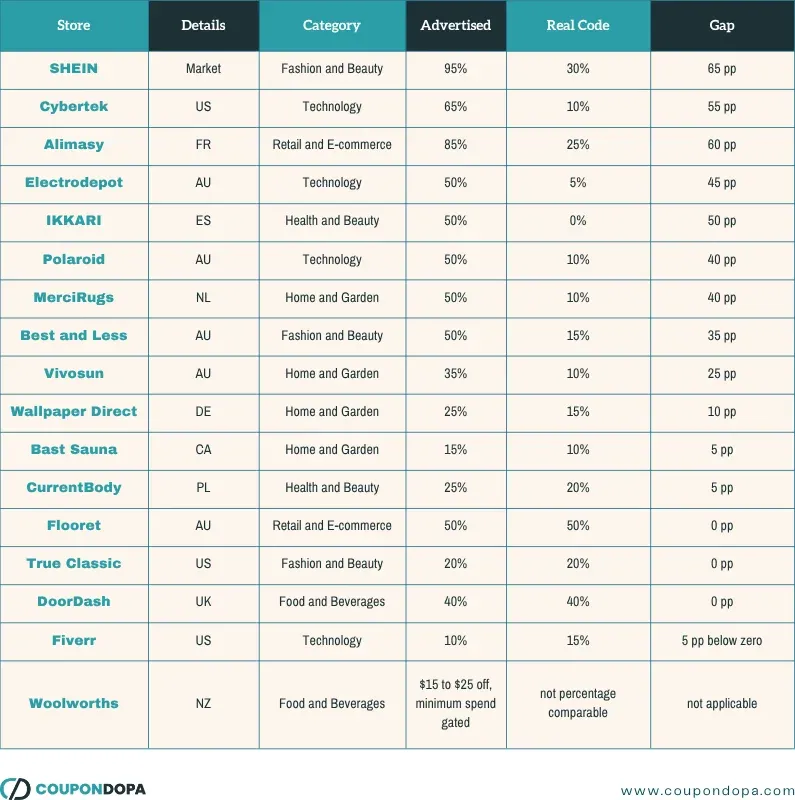
Two notes on the table above are worth reading in full.
IKKARI publicly promotes 50% off. The best confirmed offer at the time was a free product sample. This is a case where a retailer's own advertised headline outpaces what shoppers can actually redeem, which is exactly the kind of gap CouponDopa's verification process exists to catch.
Fiverr is the one retailer where the verified code, at 15%, is larger than the retailer's own advertised headline of 10%. Here the retailer undersells its own offer, and CouponDopa's checking surfaced a better deal than the brand's own marketing promised.
A Verified Checkout Test: CurrentBody's "Save 20%" Code
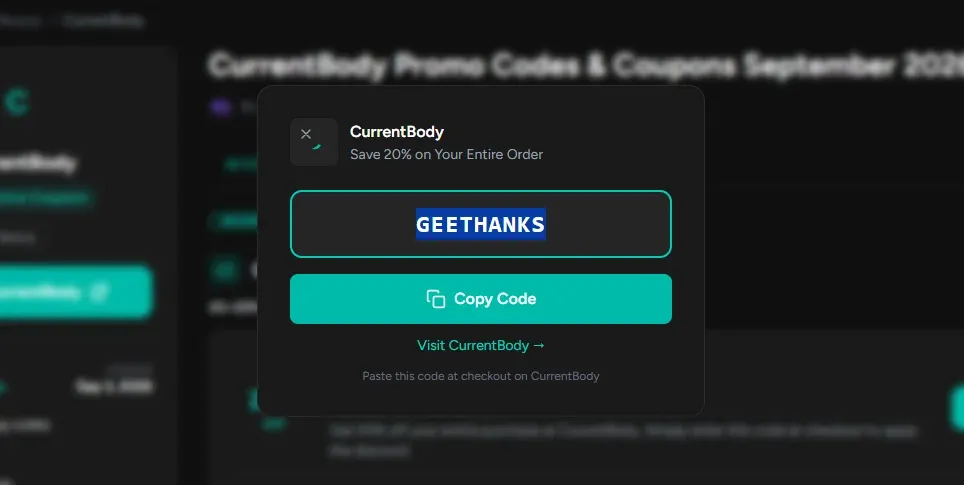
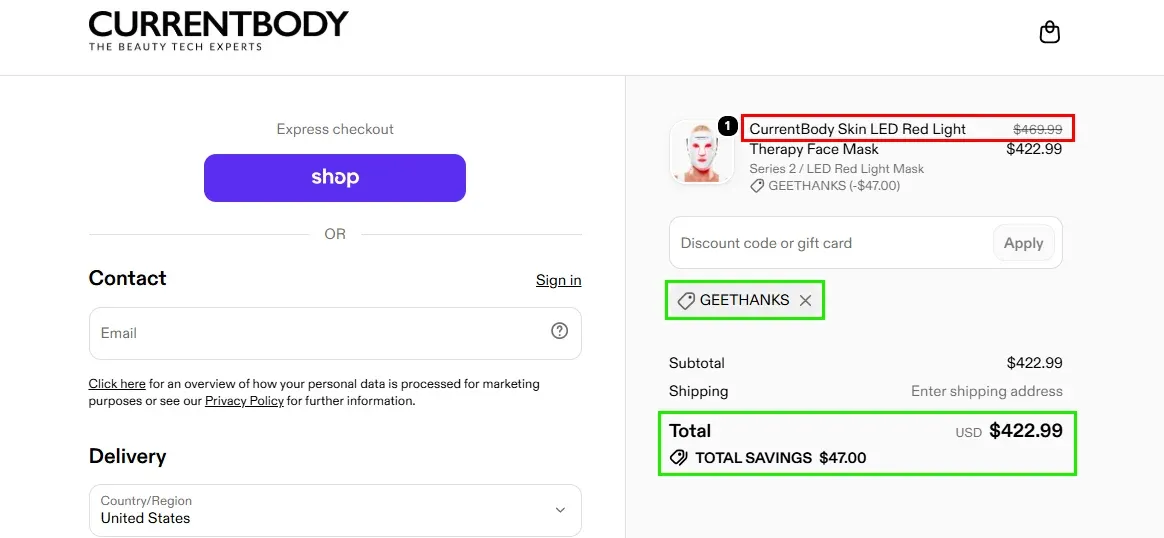
To see how this plays out in a real purchase, we ran a manual checkout test using a coupon listing found on a random coupon industry site for CurrentBody. The listing advertised "Save 20% on Your Entire Order" with the code GEETHANKS. We applied the code at checkout on a genuine order, the CurrentBody Skin LED Red Light Therapy Face Mask, listed at $469.99. Instead of the 20% reduction promised on the coupon banner, the checkout page showed a total savings of $47.00, with a final price of $422.99.
Based on the order total, a genuine 20% discount should have reduced the price by $93.99, not $47.00. The code delivered roughly 10% off the order, exactly half of what the coupon listing advertised. This is a useful, concrete example of the same pattern found across the wider 17 retailer check: an advertised headline percentage and the real reduction applied at checkout can differ substantially, and the only way to know the true saving is to test the code directly against a real order rather than trust the number on the coupon banner.
The Biggest Discount Claims Don't Always Mean the Biggest Savings
The first assumption we tested was something most shoppers naturally believe: a bigger discount percentage should mean a better deal. A product advertised at 65% off should provide more value than one advertised at 20% off. At least, that is how discount marketing is designed to work.
When we compared advertised headlines with the real sitewide codes, the relationship was not that simple. Three stores, Flooret, True Classic, and DoorDash, had no gap at all. Their advertised discount and their real code matched exactly. Six stores had gaps of 40 percentage points or more.
This happens because larger promotions often come with more conditions attached. A retailer may advertise a striking percentage while limiting it to a small group of products, a clearance category, or a specific accessory line.
How Often Does "50% Off or Higher" Actually Apply?
Eight of the retailers checked advertised a headline of 50% or higher: Best and Less, Flooret, Alimasy, IKKARI, MerciRugs, Polaroid, Electrodepot, and SHEIN. Here is what we found among them.
|
Measurement |
Result |
|
Retailers analyzed |
8 |
|
Average advertised discount |
65.6% |
|
Average real sitewide code |
18.1% |
|
Average discount gap |
47.5 pp |
In seven of these eight cases, the large advertised percentage represented a category specific or clearance only maximum rather than the code an average shopper could apply to a normal sitewide purchase.
Straight Percentage Discounts Compared With "Up To" Discounts
|
Promotion Type |
Retailers |
Avg Advertised |
Avg Real Code |
Avg Gap |
|
Straight percentage phrasing |
Flooret, IKKARI, True Classic, SHEIN, DoorDash, Fiverr, Bast Sauna |
45.7% |
22.1% |
23.6 pp |
|
"Up to" phrasing |
Best and Less, CurrentBody, Alimasy, MerciRugs, Cybertek, Vivosun, Wallpaper Direct, Polaroid, Electrodepot |
46.1% |
12.2% |
33.9 pp |
"Up to" phrasing showed a larger average gap in this sample, consistent with the idea that this wording sets an expectation at the maximum rather than the typical outcome. That said, the pattern is not absolute. SHEIN and IKKARI, both using straight percentage phrasing, still produced two of the largest gaps in the whole dataset, so wording alone does not guarantee accuracy.
Category Discount Performance
|
Category |
Retailers |
Avg Advertised |
Avg Real Code |
Avg Gap |
|
Technology |
Cybertek, Fiverr, Polaroid, Electrodepot |
43.8% |
10.0% |
33.8 pp |
|
Fashion and Beauty |
Best and Less, True Classic, SHEIN |
55.0% |
21.7% |
33.3 pp |
|
Retail and E-commerce |
Flooret, Alimasy |
67.5% |
37.5% |
30.0 pp |
|
Health and Beauty |
CurrentBody, IKKARI |
37.5% |
10.0% |
27.5 pp |
|
Home and Garden |
MerciRugs, Vivosun, Wallpaper Direct, Bast Sauna |
31.3% |
11.3% |
20.0 pp |
|
Food and Beverages |
Comparable retailer, DoorDash |
40.0% |
40.0% |
0 pp |
Technology
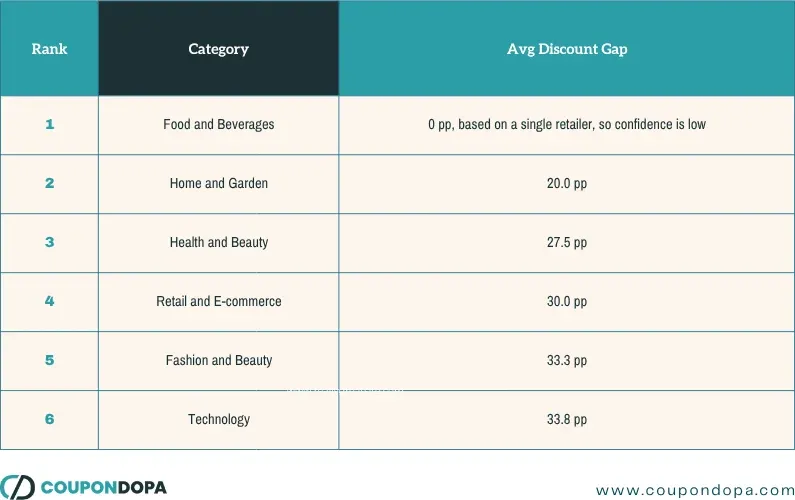
Technology retailers showed the largest average gap of any category with real data behind it, at 33.8 percentage points. Every technology retailer checked advertised a headline in the 50 to 65% range, but real sitewide codes clustered tightly around 5 to 15%. Electrodepot's real code of 5% was the smallest sitewide discount found anywhere in the entire dataset, set against a 50% headline.
Home and Garden
Home and Garden had the smallest average gap among multi brand categories, at 20.0 percentage points. This is largely because Bast Sauna, with a 5 percentage point gap, and Wallpaper Direct, with a 10 percentage point gap, both stayed close to their advertised numbers.
Fashion and Beauty
Fashion and Beauty produced the single largest gap in the entire dataset through SHEIN, at 65 percentage points, but also one of the three retailers with a perfect match, True Classic. The category average of 33.3 percentage points rests almost entirely on that one outlier. Without SHEIN, Fashion and Beauty's average gap would sit closer to 17.5 percentage points.
Category Ranking From Smallest Gap To Largest
Retailer Results Across 10 Markets
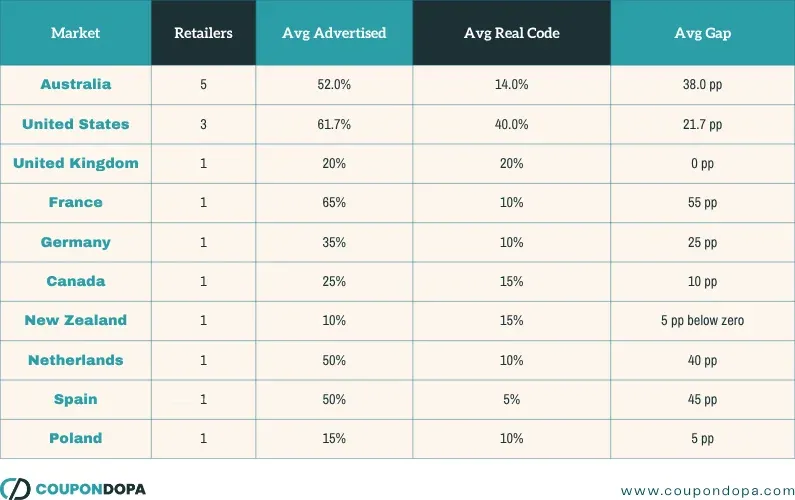
Seven of these ten markets are represented by a single retailer. A single retailer row should be read as a data point about that specific store, not as a market wide pattern. Cybertek's 55 percentage point gap describes Cybertek, not France as a whole, and a second French retailer could look very different.
Retailers With The Smallest Discount Gaps
|
Rank |
Retailer |
Advertised |
Real Code |
Gap |
|
1 |
Fiverr |
10% |
15% |
−5 pp |
|
2 |
Flooret |
50% |
50% |
0 pp |
|
2 |
True Classic |
20% |
20% |
0 pp |
|
2 |
DoorDash |
40% |
40% |
0 pp |
|
5 |
Bast Sauna |
15% |
10% |
5 pp |
|
5 |
CurrentBody |
25% |
20% |
5 pp |
|
7 |
Wallpaper Direct |
25% |
15% |
10 pp |
Note: A negative gap means the verified code exceeded the retailer’s advertised discount.
Retailers With The Largest Discount Gaps
|
Rank |
Retailer |
Advertised |
Real Code |
Gap |
|
1 |
SHEIN |
95% |
30% |
65 pp |
|
2 |
Alimasy |
85% |
25% |
60 pp |
|
3 |
Cybertek |
65% |
10% |
55 pp |
|
4 |
IKKARI |
50% |
0% |
50 pp |
|
5 |
Electrodepot |
50% |
5% |
45 pp |
|
6 |
Polaroid |
50% |
10% |
40 pp |
|
6 |
MerciRugs |
50% |
10% |
40 pp |
|
8 |
Best and Less |
50% |
15% |
35 pp |
This is the complete ranked list of all 16 percentage comparable retailers checked, not a shortlist pulled from a larger pool.
Why Advertised Discounts And Real Codes Differ
The gap between advertised discounts and the real usable code usually comes from the conditions behind the promotion. Below are the reasons found stated directly in these 17 retailers' own terms.
Category or collection restriction is the most common cause. CurrentBody's 25% cap only applies to specific collections such as hyperpigmentation, anti ageing, and LED mask lines, not sitewide. Cybertek's 65% applies to phone accessories only, while its real sitewide code is 10%. Electrodepot's 50% applies to televisions only, set against a 5% sitewide code.
Clearance or flash sale gating explains several more. Best and Less caps its 50% tier to clearance stock only. Alimasy's 85% is sale collection only, against a 25% sitewide code.
Minimum spend requirements govern several dollar off codes. Woolworths' $25 off code requires a $250 spend, and its $20 off code requires $200. DoorDash's $15 off code requires a $30 spend.
New customer or first order restrictions apply in other cases. SHEIN's 30% codes are largely new customer or first app order only. Vivosun's 8% first order deal is separate from, and smaller than, its advertised 35% weekly offer headline.
A retailer's own advertised headline outpacing what shoppers can redeem is the clearest issue found. IKKARI publicly promotes 50% off, but no working percentage off code could be verified, only a free sample and a 10% first order deal. Cases like this are exactly why independent verification matters more than the headline number alone.
A retailer underselling its own offer appears once, in the opposite direction. Fiverr's own marketing says 10% off a first order, but the verified best sitewide code is 15%, meaning the retailer's real offer is better than its own headline suggests.
What Shoppers Should Check Before Trusting A Discount
Check whether the discount applies to the specific product in your cart rather than the store generally. Read minimum spend requirements before assuming a dollar off code applies. Look for maximum discount caps on high value purchases. Treat "up to" language as a ceiling rather than a typical outcome, since "up to" offers in this dataset carried a larger average gap than straight percentage claims. Compare the sale price against the coupon price rather than assuming the two stack automatically. Calculate the final checkout price rather than focusing on the headline percentage alone.
Key Findings At A Glance
|
Research Finding |
Result |
|
Retailers checked |
17 total, 16 percentage comparable |
|
Markets covered |
10 |
|
Average advertised discount |
44.7% |
|
Average real sitewide code |
17.8% |
|
Average discount gap |
26.9 pp |
|
Category with the smallest gap |
Home and Garden, 20.0 pp |
|
Category with the largest gap |
Technology, 33.8 pp |
|
Retailer with the smallest gap |
Fiverr, real code exceeds the advertised headline |
|
Retailer with the largest gap |
SHEIN, 65 pp |
|
Retailers with a perfect match |
Flooret, True Classic, and DoorDash, each at 0 pp |
What This Means For Online Shoppers
Discounts are useful. They help shoppers find better prices, compare products, and make purchasing decisions. A discount percentage is only the beginning of the story, and a large number on a banner does not always represent the largest saving.
Across the 17 retailers checked here, the advertised headline and the real usable code differed by an average of 26.9 percentage points. The difference came from category restrictions, clearance only pricing, minimum spend requirements, new customer gating, and in a couple of cases, from claims and coupon labels that simply did not match what was actually live on the page.
This does not mean discounts are unreliable. It means shoppers need to check the real, verified code, not just the headline percentage, before assuming they know what they will pay. This is the gap CouponDopa's verification process is built to close, by testing codes directly rather than repeating what a retailer's marketing promises.
FAQs
Are advertised discounts always misleading?
No. Three of the 17 retailers checked here, Flooret, True Classic, and DoorDash, matched their advertised headline exactly. Many advertised discounts accurately represent what is available, while some do not.
What is a discount gap?
The difference between a retailer's advertised headline discount and the real sitewide code a shopper can actually use. The formula is advertised discount minus real code equals discount gap.
Why are "up to" discounts different?
"Up to" language states the highest possible saving available, not necessarily what most shoppers receive. In this research, "up to" offers had a larger average gap of 33.9 percentage points compared with 23.6 percentage points for straight percentage claims.
Are bigger advertised discounts always better?
No. Fiverr advertised the smallest headline in the dataset at 10%, but delivered the largest real code relative to its own claim. Its actual sitewide code of 15% exceeded what it advertised.
How can shoppers find genuine deals?
Look for verified codes rather than relying on a headline percentage in a title or advertisement, read the terms for category or spend restrictions, and calculate the real checkout price before assuming a deal is as large as advertised.
Why did CouponDopa run this research?
To show shoppers how advertised discounts compare to real, verified savings across the market, based on real, named retailers, and to demonstrate the value of checking a code before trusting a headline number.