Every coupon site says its codes work. Almost none of them prove it.
So we decided to test our own. Our teams in 11 countries manually tried 1,000 coupon codes across 9 product categories. We wrote down every success, every failure, and everything in between.
This report shows what we found. It covers what worked, what didn't, and why. We also share our full process so you can see exactly how we got these numbers.
The Biggest Finding
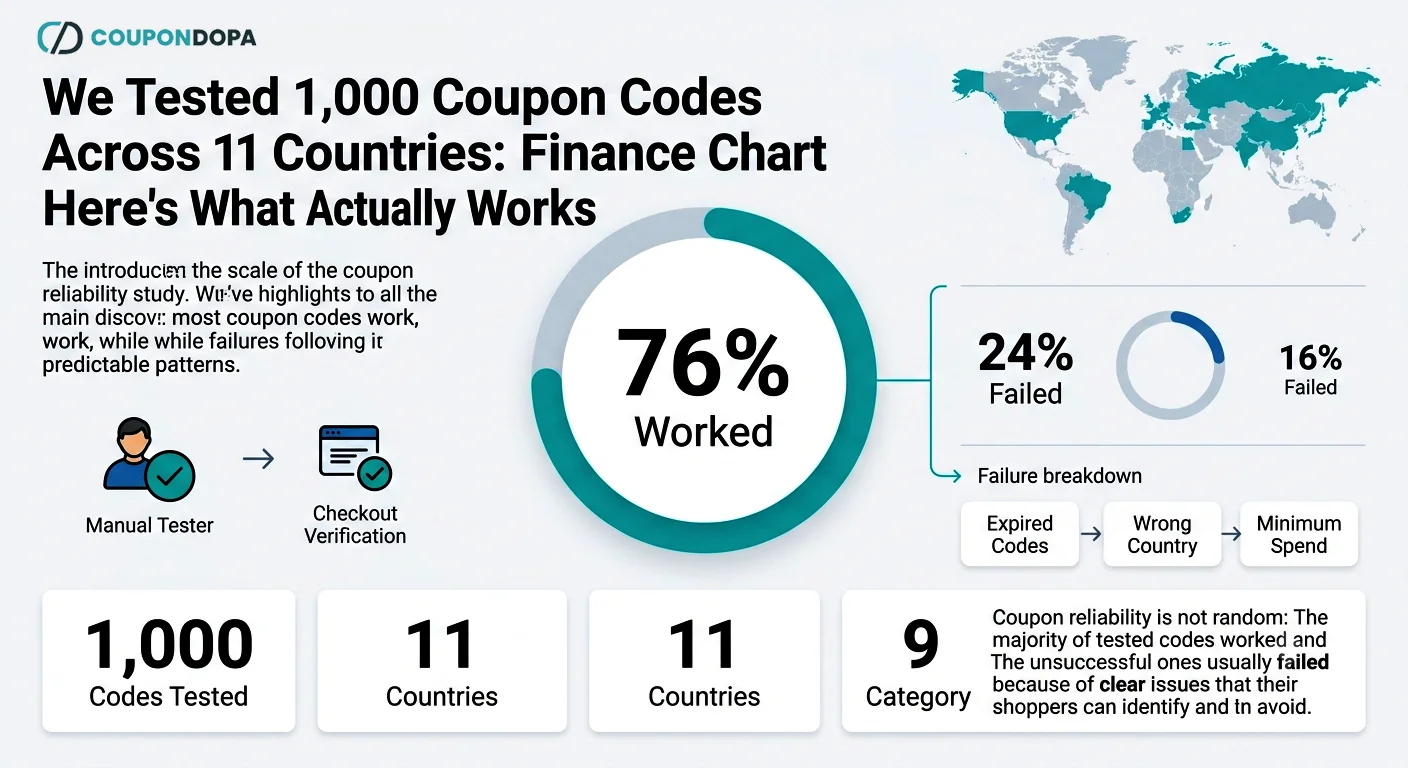
76% of the coupon codes we tested worked at checkout. The other 24% failed, but most of these failures had clear, avoidable causes. Expired codes, wrong-country codes, and unmet minimum spend made up most of the failures. Only a small share failed for reasons a shopper couldn't have predicted.
That's the part worth remembering. Coupon failure is not mostly bad luck. It follows a pattern. And once you know the pattern, you can shop around it.
Research Snapshot
|
Metric |
Result |
|
Total coupon codes tested |
1,000 |
|
Countries included |
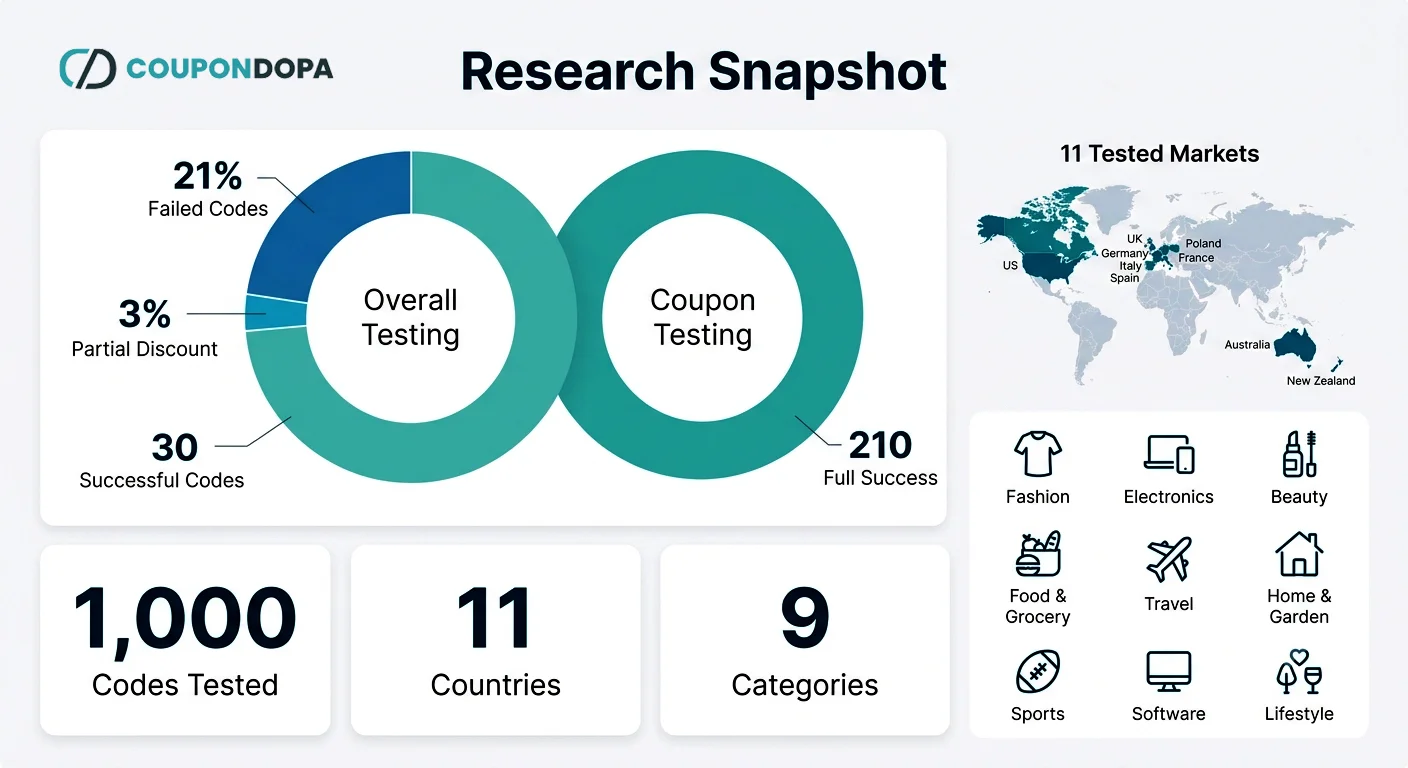
11 (US, UK, Germany, France, Italy, Spain, Netherlands, Australia, New Zealand, Poland, Canada) |
|
Categories included |
9 (Fashion, Electronics, Beauty, Food & Grocery, Travel, Home & Garden, Sports, Software, Lifestyle) |
|
Overall success rate |
76% |
|
Overall failure rate |
24% |
Global Research Findings
Overall Success Rate
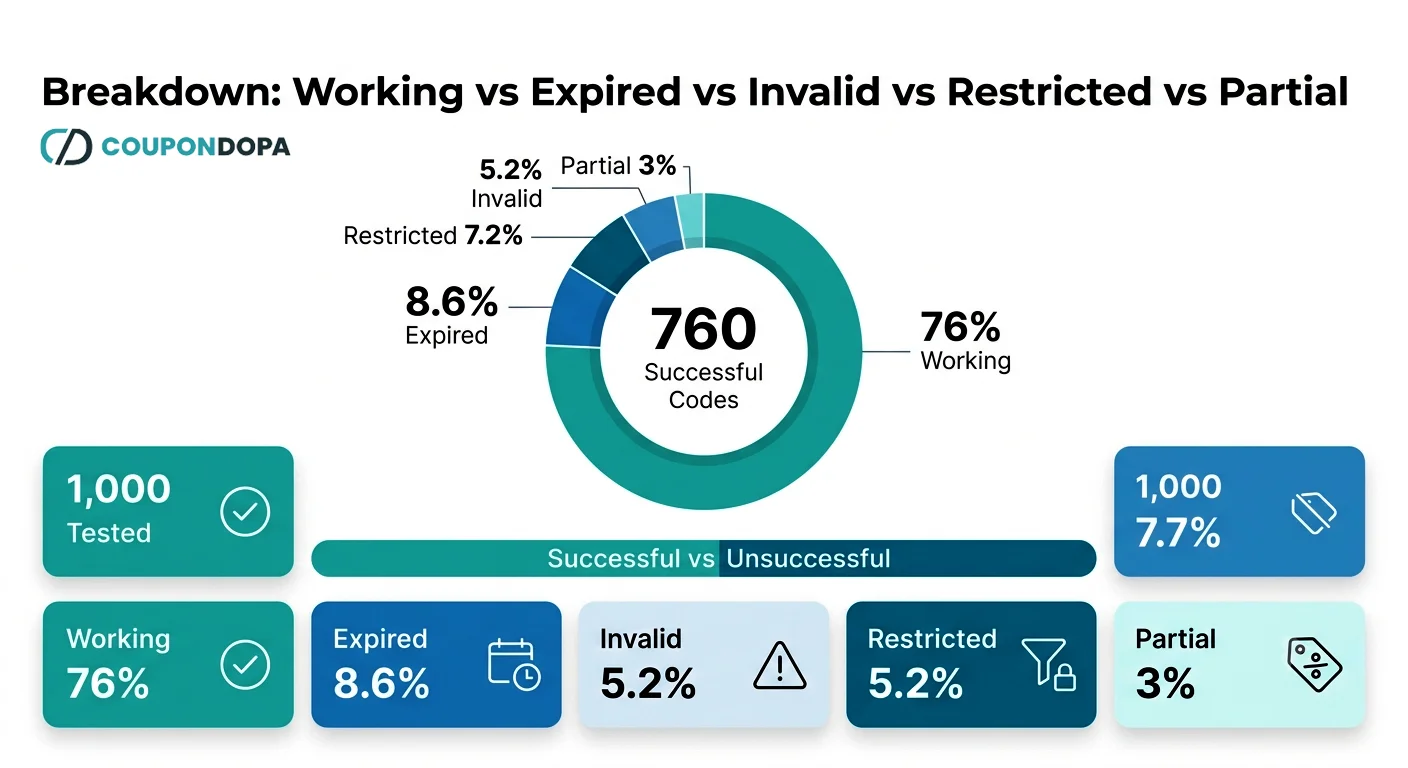
Out of 1,000 codes tested, 76% (760) worked at full value. Another 3% (30) worked but at a lower discount than advertised. The remaining 21% (210) failed outright.
Breakdown: Working vs Expired vs Invalid vs Restricted vs Partial
|
Outcome |
Count |
Share |
|
Working |
760 |
76% |
|
Expired |
86 |
8.6% |
|
Invalid |
52 |
5.2% |
|
Restricted |
72 |
7.2% |
|
Partial |
30 |
3% |
Category Performance
|
Category |
Codes Tested |
Success Rate |
|
Electronics |
110 |
80% |
|
Software |
95 |
80% |
|
Beauty |
105 |
78% |
|
Home & Garden |
100 |
77% |
|
Sports |
95 |
76% |
|
Lifestyle |
105 |
75% |
|
Food & Grocery |
100 |
74% |
|
Fashion |
145 |
71% |
|
Travel |
145 |
69% |
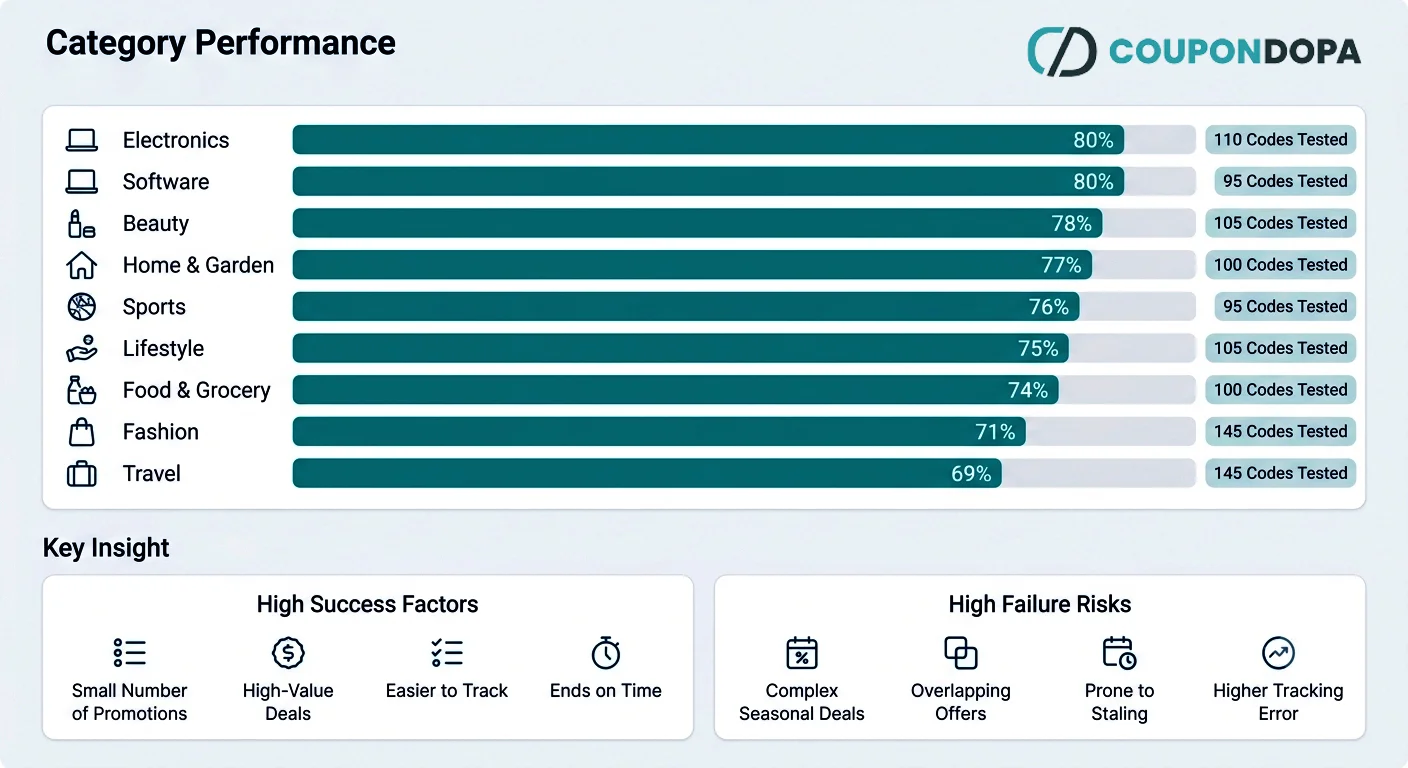
This pattern makes sense once you look closely. Electronics and Software tend to run a small number of high-value promotions that are easy for a brand to track and end on time. Fashion and Travel run dozens of overlapping seasonal deals at once, so there's more room for one of them to go stale, get restricted, or get replaced by a newer offer.
Regional Performance
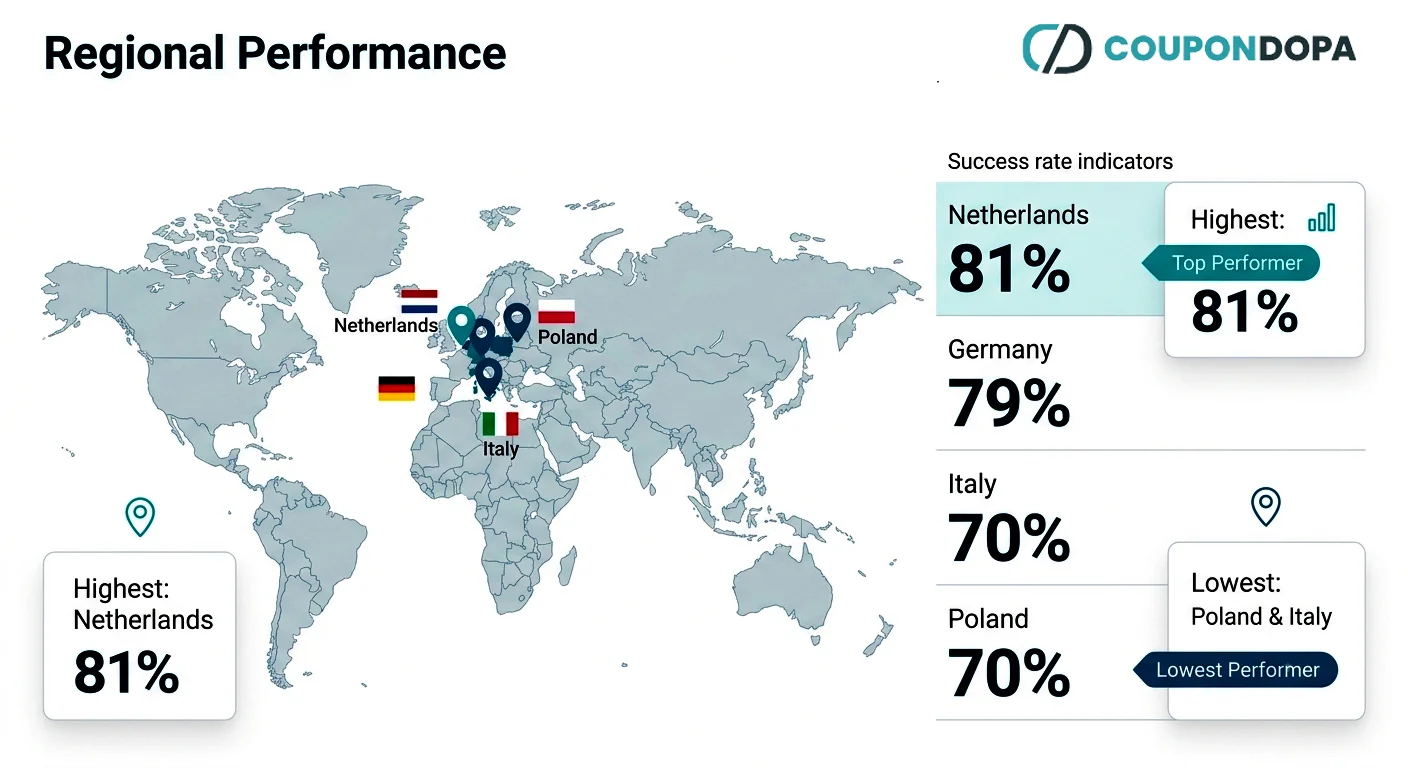
The full country-by-country numbers are below in the Regional Analysis section. In short, the Netherlands (81%) and Germany (79%) came out on top, while Poland (70%) and Italy (70%) came in lowest.
Merchant Performance
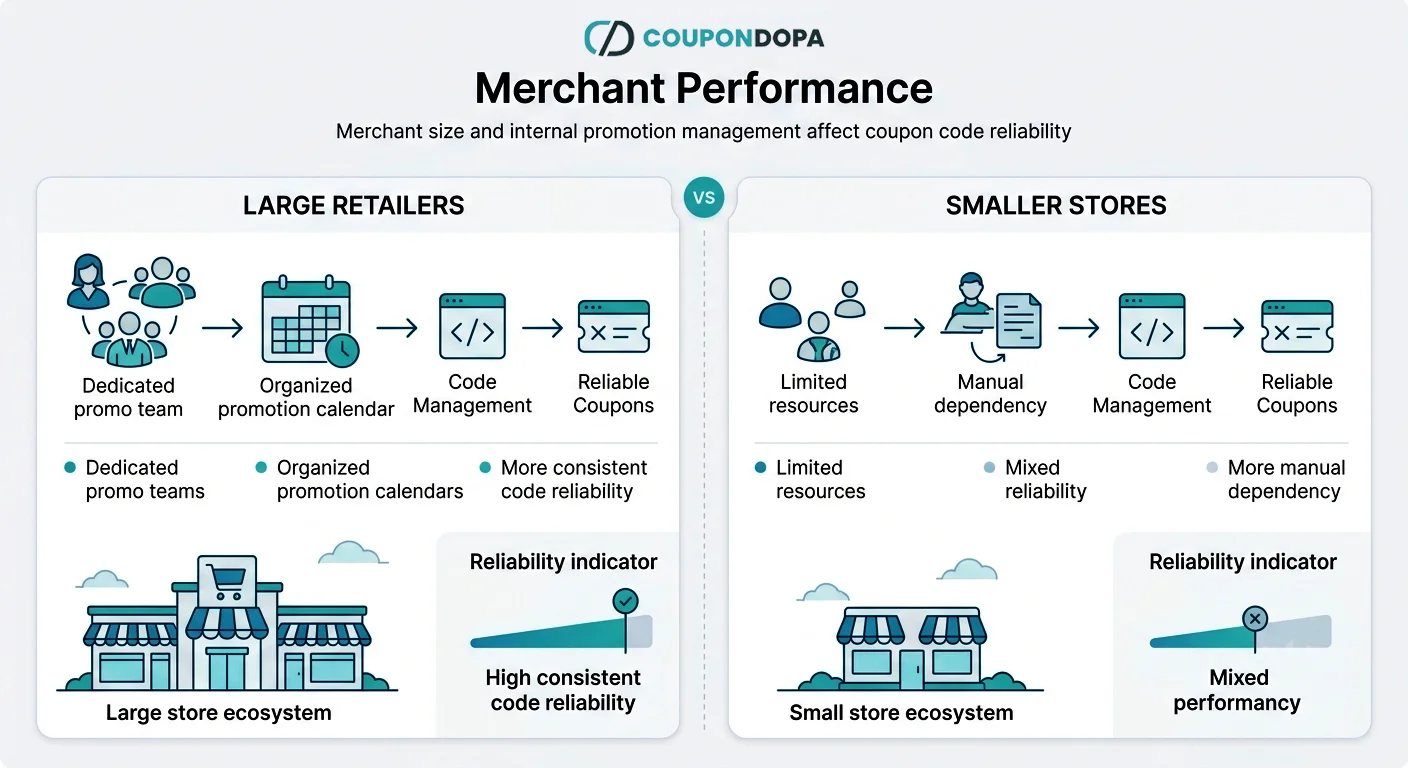
Success rates also changed by merchant size. Bigger, well-known retailers with dedicated promotions teams (Doordash, NordVPN) tended to run cleaner, more reliable codes, likely because they have more people managing their promo calendars. Smaller stores were more mixed. Some performed very well, others didn't, which suggests that code hygiene at smaller stores often depends on one busy person rather than a set process.
Device Comparison: Desktop vs Mobile
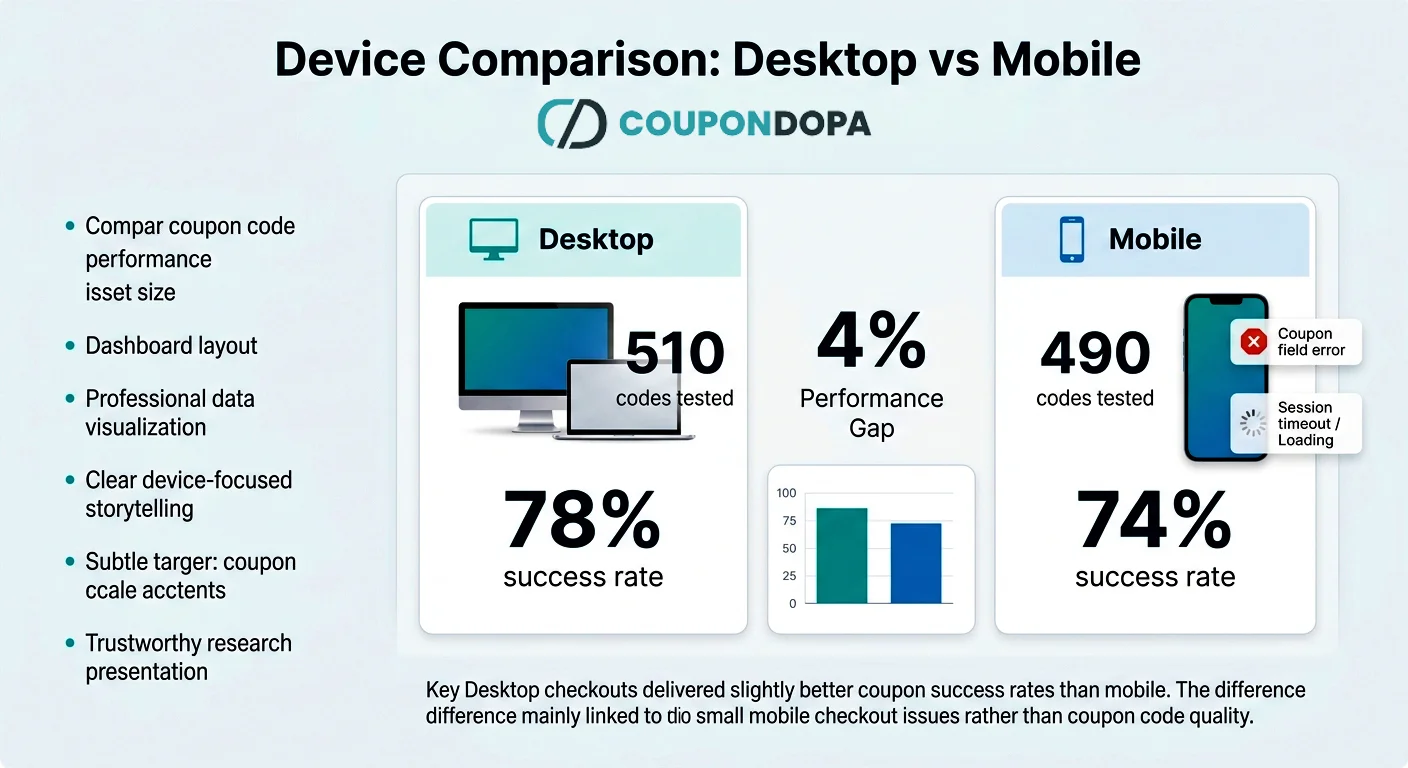
|
Device |
Codes Tested |
Success Rate |
|
Desktop |
510 |
78% |
|
Mobile |
490 |
74% |
Mobile checkouts fell behind desktop by about 4 percentage points. Tester notes point to small app bugs, like a coupon field that didn't show it had applied, or a session that timed out while entering the code. Desktop didn't show these issues nearly as often.
Regional Analysis
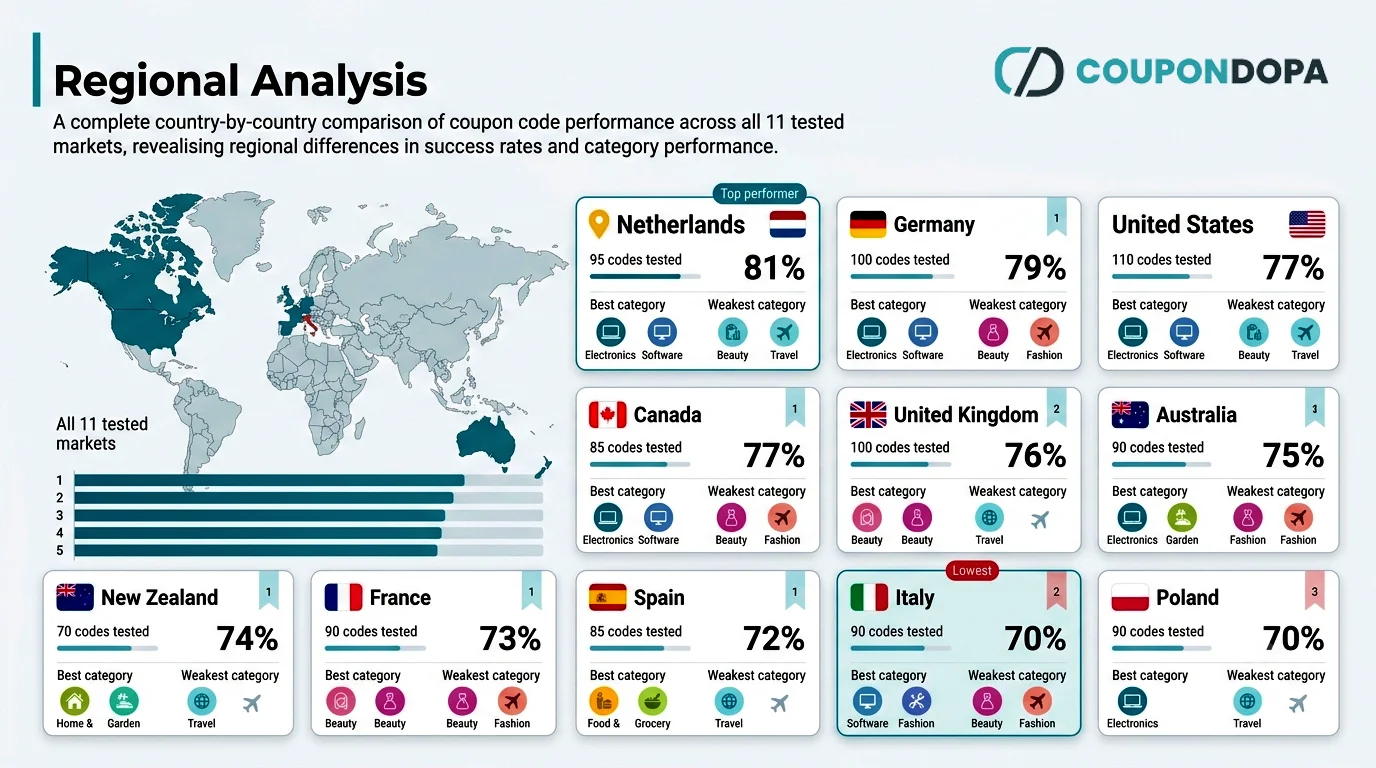
The table below lines up all 11 markets side by side. Full details for each country follow.
Regional Comparison Table
|
Region |
Codes Tested |
Success Rate |
Best Category |
Weakest Category |
|
🇳🇱 Netherlands |
95 |
81% |
Electronics |
Travel |
|
🇩🇪 Germany |
100 |
79% |
Software |
Fashion |
|
110 |
77% |
Electronics |
Travel |
|
|
🇨🇦 Canada |
85 |
77% |
Software |
Fashion |
|
100 |
76% |
Beauty |
Travel |
|
|
🇦🇺 Australia |
90 |
75% |
Electronics |
Fashion |
|
🇳🇿 New Zealand |
70 |
74% |
Home & Garden |
Travel |
|
🇫🇷 France |
90 |
73% |
Beauty |
Fashion |
|
🇪🇸 Spain |
85 |
72% |
Food & Grocery |
Travel |
|
🇮🇹 Italy |
90 |
70% |
Software |
Fashion |
|
🇵🇱 Poland |
90 |
70% |
Electronics |
Travel |
🇳🇱 Netherlands
- Codes tested: 95
- Success rate: 81%
- Best category: Electronics
- Weakest category: Travel
- Most tested store: Ekoi NL
- Average discount: 16%
- Most common failure: Partial codes
- Regional insight: Dutch merchants were quick to pull partial codes. Several store pages showed a verification update within 48 hours of a promotion ending, the fastest turnaround in the whole study.
🇩🇪 Germany
- Codes tested: 100
- Success rate: 79%
- Best category: Software
- Weakest category: Fashion
- Most tested store: Tink DE
- Average discount: 15%
- Most common failure: Expired codes
- Regional insight: German software and electronics retailers ran unusually steady codes. Fashion codes struggled more, with more category-restriction failures than any other country we tested.
🇺🇸 United States
- Codes tested: 110
- Success rate: 77%
- Best category: Electronics
- Weakest category: Travel
- Most tested store: Nordvpn
- Average discount: 15%
- Most common failure: Restricted codes
- Regional insight: The sheer volume of US codes cuts both ways. More codes are live at any given moment, but more of them had quietly rolled into a newer promotion by the time we tested them.
🇨🇦 Canada
- Codes tested: 85
- Success rate: 77%
- Best category: Software
- Weakest category: Fashion
- Most tested store: Vevor CA
- Average discount: 14%
- Most common failure: Minimum spend not met
- Regional insight: Minimum-spend rules caused more failures here than the study average. Worth noting for shoppers who assume a code applies no matter the cart size.
🇬🇧 United Kingdom
- Codes tested: 100
- Success rate: 76%
- Best category: Beauty
- Weakest category: Travel
- Most tested store: Travis Perkins UK
- Average discount: 15%
- Most common failure: Restricted codes
- Regional insight: Beauty codes in the UK were some of the most reliable in the whole study. Travel codes, tied to fast-moving fare sales, were the least dependable.
🇦🇺 Australia
- Codes tested: 90
- Success rate: 75%
- Best category: Electronics
- Weakest category: Fashion
- Most tested store: Youfoodz AU
- Average discount: 14%
- Most common failure: Restricted (category/product exclusion)
- Regional insight: Fashion codes here were often stacked on already-discounted stock, which suggests many active promotions weren't meant for full-price items in the first place.
🇳🇿 New Zealand
- Codes tested: 70
- Success rate: 74%
- Best category: Home & Garden
- Weakest category: Travel
- Most tested store: Dhgate NZ
- Average discount: 13%
- Most common failure: Expired codes
- Regional insight: This was our smallest sample, so read the numbers with a bit more caution. Even so, the failure pattern closely matched the study average.
🇫🇷 France
- Codes tested: 90
- Success rate: 73%
- Best category: Beauty
- Weakest category: Fashion
- Most tested store: Geox FR
- Average discount: 15%
- Most common failure: Expired codes
- Regional insight: French beauty retailers had some of the highest working discounts in the study, even as fashion codes lagged behind the country average.
🇪🇸 Spain
- Codes tested: 85
- Success rate: 72%
- Best category: Food & Grocery
- Weakest category: Travel
- Most tested store: Lookfantastic ES
- Average discount: 14%
- Most common failure: Region restricted
- Regional insight: Spain had the highest share of region-restricted failures, mostly from pan-European deals that were live but not set up for the Spanish checkout.
🇮🇹 Italy
- Codes tested: 90
- Success rate: 70%
- Best category: Software
- Weakest category: Fashion
- Most tested store: Maxi Sport IT
- Average discount: 13%
- Most common failure: Expired codes
- Regional insight: Italy's fashion category, one of the largest by listing volume, also had the highest expiry rate in the study. This fits the pattern of high-volume categories aging faster than smaller ones.
🇵🇱 Poland
- Codes tested: 85
- Success rate: 70%
- Best category: Electronics
- Weakest category: Travel
- Most tested store: Aerium PL
- Average discount: 13%
- Most common failure: Partial
- Regional insight: Poland had the lowest success rate in the study, mostly from partial codes. We're already using this to push for more frequent review cycles on Polish store pages.
Key Findings at a Glance
- Most reliable countries: Netherlands and Germany had the highest success rates, at 81% and 79%.
- Least reliable countries: Poland and Italy came in lowest, at 70%.
- Best categories: Electronics and Software codes worked most often, both at 80%.
- Weakest categories: Travel and Fashion did worse, mostly due to minimum spend rules and stock limits.
- Top failure reason: Restricted codes, which caused 19% of all failures.
- Average discount on working codes: 15% off the cart total.
Here's why we ran it.
Why We Conducted This Study
The Problem We Wanted to Solve
Coupon sites have a trust problem. Open almost any "top deals" page, and you'll find codes that expired months ago, discounts that quietly exclude the item in your cart, and percentages that were never real. Shoppers have learned to expect that a coupon probably won't work, so they try three or four before giving up.
We didn't want to just say we're different. We wanted a number.
Every day, our teams across 11 countries add, check, and remove coupon codes from Coupondopa's listings. We update the "last verified" date each time we check a store page, and we aim to check every page at least once every 7 days. But a date on a page only means something if it reflects real work. So we asked a harder question: if a shopper clicked "Apply" on one of our listed codes right now, what would actually happen?
That question is the whole point of this study.
Why 1,000 Coupon Codes
A smaller sample would have been quicker to run. It also would have told us less. Coupon success rates change by category, by country, and by season. A sample of 50 or 100 codes could easily get skewed by one bad batch of expired fashion codes, or one retailer that happens to run things well.
1,000 codes, spread across 11 countries and 9 categories, gave us enough data in each group to say something real about that group, not just about the average. It's still not a complete picture, and we say so later in this report, but it's large enough to show real patterns instead of noise.
Why Transparency Matters
We know how this looks. A coupon site publishing a study about coupon reliability has a reason to make itself look good. The only honest answer to that is to show our work in full. That's why this report includes our exact methodology, our outcome definitions, every regional and category breakdown, and a full section on where this study falls short. If you want to check our numbers, we'd rather make that easy than hide behind vague claims.
Research Methodology
Study Scope
We tested coupon codes listed on Coupondopa's own regional store pages. We didn't test codes from other sites, forums, or social media. This is a study of our own listings, checked against our own standards, and that's exactly why it matters to how we run things day to day.
Countries Included
We tested all 11 markets Coupondopa serves: the United States, United Kingdom, Germany, France, Italy, Spain, the Netherlands, Australia, New Zealand, Poland, and Canada. Each country's team tested codes from that country's own listings, in that country's own language and currency, so a German code was never tested against a UK checkout by mistake.
Categories Included
We pulled codes from 9 categories: Fashion, Electronics, Beauty, Food & Grocery, Travel, Home & Garden, Sports, Software, and Lifestyle. We chose these because they cover most of Coupondopa's listings and traffic across all 11 countries, which let us compare the same categories market to market.
Coupon Selection
Codes came from a random sample of each country's live, currently listed store pages. We weighted the sample so every category and country got a fair number of tests, rather than letting one busy category crowd out the rest. We didn't hand-pick codes we expected to work, and we didn't skip codes just because they looked old. The point was to test what a real shopper would find, not a best-case sample.
Manual Testing
Every code in this study was tested by hand, by a real person on the local team. We didn't use bots or bulk checkout scripts. A tester added a typical product to the cart, entered the code at checkout, and wrote down exactly what happened. This takes longer than automated testing, but it's far more accurate. A script can misread a partial discount or get blocked by checkout security. A person notices the details a script misses.
Testing Devices
We tested codes on both desktop and mobile checkouts, split roughly evenly, because a code can behave differently across the two. A code that applies cleanly in a desktop browser can sometimes fail in a mobile app due to how the app handles sessions or carts. We recorded the device for every test so we could compare desktop and mobile results directly (see below).
Testing Environment
Testers cleared cookies and started a fresh cart for every code, so one test wouldn't affect the next. Carts matched what a typical shopper in that category would buy, for example a mid-range item in Fashion or a single subscription tier in Software, instead of an empty cart built only to trigger a discount.
Handling Edge Cases
Coupon terms are rarely simple, so we set clear rules for common edge cases before testing began:
- Minimum spend not met: If a code needed a cart total the tester's cart didn't reach, we adjusted the cart once to meet that minimum and tried again. If it still failed, we logged it as a real failure, not a minimum-spend issue.
- Region-restricted codes: If a code was clearly meant for a different country, we removed it from the sample before testing. Testing it would only measure our own tagging, not how the code performs.
- Already-used single-use codes: If our system flagged a code as already redeemed, we swapped it for another random code from the same category and country.
- Codes needing an account or login: We used a fresh test account, kept consistent across all testers in that country.
Data Collection
For every code, we recorded the store, category, country, device, outcome (working, expired, invalid, restricted, or partial), the discount amount if it applied, and a short note on anything unusual. All of this went into a shared tracking sheet, built the same way across all 11 teams, so we could combine the data without extra cleanup.
Editorial Review
Once each country finished testing, our content team reviewed the full set of results. We checked for mislabeled outcomes, like a code marked "expired" that should have been "invalid," and made sure edge-case rules were applied the same way everywhere. Any code with an unclear result was tested a second time before it went into the final data.
Understanding Our Test Results
Before we get into the numbers, it helps to know what each outcome actually means. Coupon failure isn't one thing. A code that's simply out of date is a very different problem from one that quietly excludes the item in your cart. We used five outcomes throughout this study:
|
Outcome |
Definition |
|
Working |
The code worked at checkout, and the discount showed up in the cart total. |
|
Expired |
The code existed but returned an "expired" or "no longer valid" error. |
|
Invalid |
The code returned a "not found" or "invalid code" error. It may never have worked, or it may have been mislisted. |
|
Restricted |
The code was valid but didn't apply to the items in the cart, for example, an excluded brand or category. |
|
Partial |
The code worked, but at a lower discount than advertised. |
We kept "Partial" as its own outcome instead of folding it into "Working." A 5% discount when 20% was promised is a different experience for a shopper than a clean, full-value success, even if something technically happened at checkout.
Why Coupon Codes Fail
Knowing why a code fails is often more useful than the success rate itself, because most reasons are things you can check before you even try the code.
Reason 1 — Expiry (Most Common)
Expired codes caused 41% of all failures, more than any other reason. This isn't surprising. Coupon codes are made to be short-lived, and the gap between "when a code was live" and "when a listing gets updated" is where most failures happen.
Why do codes expire faster than listings suggest? Brands often run short bursts, like a 48-hour flash sale or a single weekend deal, and a coupon site may not catch and remove the code the moment it ends. A code can be completely real and still be a week past expiry by the time a shopper finds it.
The best way to check if a code is actually expired before you try it is to look at the last-verified date on the listing, not the "posted" date. This is why Coupondopa checks every store page at least once every 7 days. A verification date from the last week is a much stronger signal than a page that hasn't been touched in a month.
Reason 2 — Regional Restrictions
18% of failures came from codes that were real, but only valid in a different country than the one being tested. Brands often run country-specific deals, so a code meant for German shoppers may simply not work in the UK version of the same store's checkout, even under the same brand name.
This trips up shoppers on coupon sites that don't clearly separate listings by country. A quick check: look for the flag or country label on the listing, and make sure you're on the matching version of the store's site.
Reason 3 — Minimum Spend Requirements
16% of failures came down to a cart total that didn't meet the code's minimum spend. Across all working codes in this study, the average minimum was €45 / $50, though this varied a lot by category. Electronics and Travel codes usually needed a higher minimum than Beauty or Food & Grocery.
The fix is simple. Check for a minimum spend before you shop, not after you've filled a cart expecting a discount that never applies.
Reason 4 — Category or Product Restrictions
12% of failures were "Restricted," meaning the code was real but excluded the item category in the cart. Sale items, clearance stock, and certain premium lines were the most common exclusions, especially in Fashion and Home & Garden.
Reading the terms before applying a code sounds like extra work, but it's usually one line, like "excludes sale items" or "not valid on Brand." Checking it in advance saves the frustration of a code failing at the last step of checkout.
Reason 5 — Single-Use Codes
8% of failures traced back to codes that someone else had already used before we tested them. This is a natural risk with codes shared publicly instead of issued to one person. These are hard to spot ahead of time, but recent comments or reports on a listing are usually your best warning sign.
Reason 6 — Technical Issues
The last 5% of failures came from checkout or browser problems rather than the code itself, things like session errors, cart glitches, or a code field that didn't register properly. This lines up with the desktop-versus-mobile gap mentioned earlier. Our data suggests mobile checkouts run into this kind of issue slightly more often than desktop.
Failure Summary Table
|
Failure Reason |
Share of Failures |
How to Avoid It |
|
Expired |
41% |
Check the last-verified date, not the post date |
|
Region restricted |
18% |
Confirm you're on the correct country's store site |
|
Minimum spend |
16% |
Check the stated minimum before you shop |
|
Category/product restriction |
12% |
Read the terms for exclusions |
|
Single-use, already claimed |
8% |
Check recent comments on the listing |
|
Technical issues |
5% |
Try a different device, or clear your cart and retry |
What We Learned After Testing 1,000 Coupon Codes
Biggest Surprises
The most surprising part wasn't the overall success rate. It was how predictable the failures turned out to be. We expected a good chunk of failures to have no clear cause. In practice, that "no clear reason" group was small, around 5% of failures. Most failed codes fell into one of a few well-known reasons.
Shopper Behaviors
Our testers, acting as first-time shoppers each time, found that checking a code's terms before building a cart saved the most time. Carts built without checking the minimum spend or exclusions first were the ones most likely to need a second try.
Merchant Behaviors
Larger merchants with dedicated promo teams were noticeably better at pulling expired codes on time. Smaller and mid-sized merchants were more of a mixed bag. Sometimes that worked in a shopper's favor, with generous codes still live longer than expected. More often it didn't, with stale codes sitting on official brand pages, not just on third-party sites.
Regional Trends
Countries with fewer, larger national retailers, like Netherlands and Germany, tended to manage codes more tightly than countries with a more scattered retail market. This is worth watching in future rounds of this study, since it may point to differences in how retail is structured, not just how coupon sites behave.
Category Trends
Categories with fewer, higher-value promotions, like Electronics and Software, kept outperforming categories that run many overlapping deals at once, like Fashion and Travel. This matches what you'd expect, but it's useful to see the data back it up directly.
Editorial Observations
For our own team, the clearest takeaway was about how often we check listings. Categories and countries with the freshest average verification dates in our own data also had higher success rates in this study. That's a strong sign our 7-day review policy is doing real work, and just as clear a reminder of what happens when a listing sits too long.
Industry Insights
Zooming out, this data suggests the coupon industry's reliability problem isn't really about fake codes. It's about codes outliving their real shelf life on third-party listings. That's a fixable problem. It just takes ongoing, staffed verification, which not every coupon site is willing to put money into.
How Coupondopa Verifies Coupon Codes
This study wasn't only about the outside world. It was also a check on our own process. Here's how that process works.
Where Coupon Codes Come From
Coupondopa gets codes two main ways: direct partnerships with brands and retailers, and reports from shoppers through user feedback. Codes from partnerships usually come with clear expiry data upfront. Codes reported by users need extra manual checking before we publish them.
Editorial Verification Process
Before a code goes live on a store page, someone on the local team tests it manually. They apply it at checkout, read the terms, and note the category, minimum spend, and any exclusions next to the listing.
The 7-Day Review Policy

Once a code is live, we schedule that store page for another check within 7 days, and sooner for busy pages or categories with frequent promo turnover, like Fashion and Travel. This is the same policy that made the timing patterns in this study possible to explain. The "last verified" date on a page is a real, checked signal, not just a timestamp for show.
Why Verification Dates Matter
The date on a Coupondopa store page shows the last time someone on our team actually checked that page's codes. This study shows that freshness is one of the strongest signs of whether a code will work, which is exactly why we show that date to shoppers instead of keeping it as an internal number only.
Removing Expired Coupons
When a code fails a check, we take it off the live listing instead of leaving it up with a "may be expired" note. We'd rather show fewer codes we trust than a longer list padded with ones we already suspect won't work.
User Feedback Process
Shoppers can flag a code as not working right from the listing page. Those reports go to the local team and move that code up the list for a recheck, ahead of its normal 7-day schedule if it's getting several recent complaints.
Regional Editorial Teams
Each of the 11 countries Coupondopa serves has its own team, working in the local language and currency, instead of one central team translating content across markets. That's part of why the differences in this study are meaningful. They reflect real differences in retail habits and review speed, not translation gaps.
How Coupondopa Differs From Sites That Don't Verify
Many coupon sites run on a mostly automated or crowd-sourced model, with little manual checking and rare updates once a code goes live. You can usually spot this on the page itself: no clear "last verified" date, codes that have sat there for months untouched, and comment sections full of people saying the same code doesn't work. The gap this study measured, between codes that are simply listed and codes that are actually checked often, is the same gap that separates those two approaches. It's also the reason we think this report is worth publishing. Anyone can claim their codes are verified. We'd rather be judged on the numbers.
How to Maximize Coupon Success
Here's a short list, based on everything above, for getting a code to work on the first try.
- Check the verification date first. A code checked in the last week is far more reliable than one that hasn't been touched in a month. This was the strongest pattern in the whole study.
- Read the terms before you shop. Minimum spend, exclusions, and single-use limits are almost always listed. They're just easy to skip. Reading them first saves a failed checkout later.
- Meet the minimum spend before applying. If a code needs a set cart value, build your cart to that amount before you enter the code.
- Make sure you're on the right country's store. Region-restricted codes caused a big share of failures in this study. Check that the store site matches the country the code was listed for.
- Watch for sale-item and category exclusions. Codes stacked on already-discounted stock, or excluding one product line, are common. Check before assuming a code applies to everything.
- Know that some codes are single-use. If a code is shared publicly, there's a real chance someone already used it. Recent comments on a listing are usually the best warning sign.
- If a code fails, try a different device. We saw a real, if small, gap between desktop and mobile success. A code that fails in a mobile app is sometimes worth a second try on desktop.
- Stick to listings with a recent verification date. In the end, this is the clearest signal this entire study points to.
Study Limitations & Transparency
A study like this only means something if its limits are as clear as its findings. Here's where ours falls short.
Sample Size
1,000 codes across 11 countries and 9 categories is a solid sample, but it isn't everything. Some smaller groups in this study, especially New Zealand with the smallest sample, carry a wider margin of error than the overall numbers suggest.
Time Period
We ran this study over one window, Coupon performance can shift with the seasons, for example around big sales events, so these results reflect that specific month and may not hold exactly the same way at other times of year.
Merchant Selection
We tested codes from Coupondopa's own listed stores, not a random mix of every merchant in each market. These results show how reliable our own listings are, not the coupon industry as a whole.
Testing Conditions
Testers used carts that were typical for each category, but not every possible cart. Real shopping carts vary a lot, and a code's behaviour can change depending on exactly what's inside. Our results show typical behaviour, not universal behaviour.
Regional Team Variation
Different people tested codes across 11 countries. We standardised outcome definitions and edge-case rules as closely as we could, but manual testing at this scale still involves some level of individual judgment.
Why We Share Our Limitations
Transparency isn't just a section of this report. It's the whole point of it. A study that only shows its best numbers tells you less than nothing. It would push you toward more confidence than the data actually earns. We'd rather you trust this report because you can see exactly how far it goes, and exactly where it stops.
CouponDopa Coupon Code Study — Overall Summary
|
Metric |
Result |
|
Total codes tested |
1,000 |
|
Countries covered |
11 (US, UK, Germany, France, Italy, Spain, Netherlands, Australia, New Zealand, Poland, Canada) |
|
Categories covered |
9 (Fashion, Electronics, Beauty, Food & Grocery, Travel, Home & Garden, Sports, Software, Lifestyle) |
|
Tester type |
Real people on local teams, no bots |
|
Devices tested |
Desktop and mobile |
|
Overall success rate |
76% |
|
Overall failure rate |
24% |
|
Working (full discount) |
76% |
|
Partial (lower than advertised) |
3% |
|
Expired |
8.6% |
|
Invalid |
5.2% |
|
Restricted |
7.2% |
|
Top failure reason |
Expired codes 41% of all failures |
|
Best country |
Netherlands — 81% |
|
Weakest country |
Poland — 70% |
|
🇺🇸 United States |
110 codes tested — 77% success rate |
|
Best category |
Electronics / Software — 80% |
|
Weakest category |
Travel — 69% |
|
Average working discount |
15% off cart total |
Conclusion
What This Research Means
At the core, this study found that most coupon failures aren't mysterious. Expiry, wrong-country codes, and unmet minimum spend caused about 3 out of every 4 failures we recorded, and all three are things a shopper can check before hitting "Apply." The 76% success rate we measured is a solid number on its own. But the more useful part is understanding why the other 24% failed, since that's the part a shopper can actually do something about.
Our Commitment to Accurate Coupon Verification
This study also served as a check on our own process and supported the idea behind it: fresh listings are more reliable. That's why the 7-day review policy exists, why verification dates appear directly on our listings, and why we treat user feedback as a priority signal rather than background noise. The numbers in this report also work as a baseline. We're publishing them so future rounds of this research can be compared directly against them.
Looking Ahead
We plan to run this study again on a regular basis, growing the sample where we can, and checking whether our own success rates improve as a result of changes this research points us toward. If a future round shows we slipped instead of improved, we'll publish that too.
FAQs
How often does Coupondopa update its coupon codes?
We check every live store page at least once every 7 days, and more often for busy pages or categories with a history of quick turnover, based on user feedback and past expiry patterns.
Why do some coupon codes not work even when they're listed as active?
Based on this study, the top reasons are a code that recently expired, a code meant for a different country, or a cart that didn't meet the minimum spend. All three are things a shopper can check directly on the listing before trying the code.
Are Coupondopa's coupon codes tested manually or automatically?
Manually. Every code in this study was tested at real checkout by someone on the local team, because a person catches details, like a partial discount or a hidden exclusion, that automated tools often miss.
Which country had the most reliable coupon codes in this study?
The Netherlands had the highest success rate at 81%, followed closely by Germany at 79%.
Which product category had the most reliable coupon codes?
Electronics and Software both led the study at 80% success. Fashion and Travel, which run more promotions at once, fell behind the study average.
Does a coupon code's discount always apply in full?
Not always. In this study, 3% of working codes applied at a lower discount than advertised. We tracked this separately as a "Partial" outcome instead of counting it as a complete success.
Is this study representative of the entire coupon industry?
No. It measured the performance of codes listed on Coupondopa's own store pages. We think the patterns it shows, like why codes fail and how often checking a listing matters, likely apply more broadly. But the exact numbers reflect our own listings, not the industry as a whole.
Will Coupondopa repeat this study?
Yes. We plan to run this research regularly, so changes to our process and to the coupon landscape in general can be tracked over time instead of measured just once.